
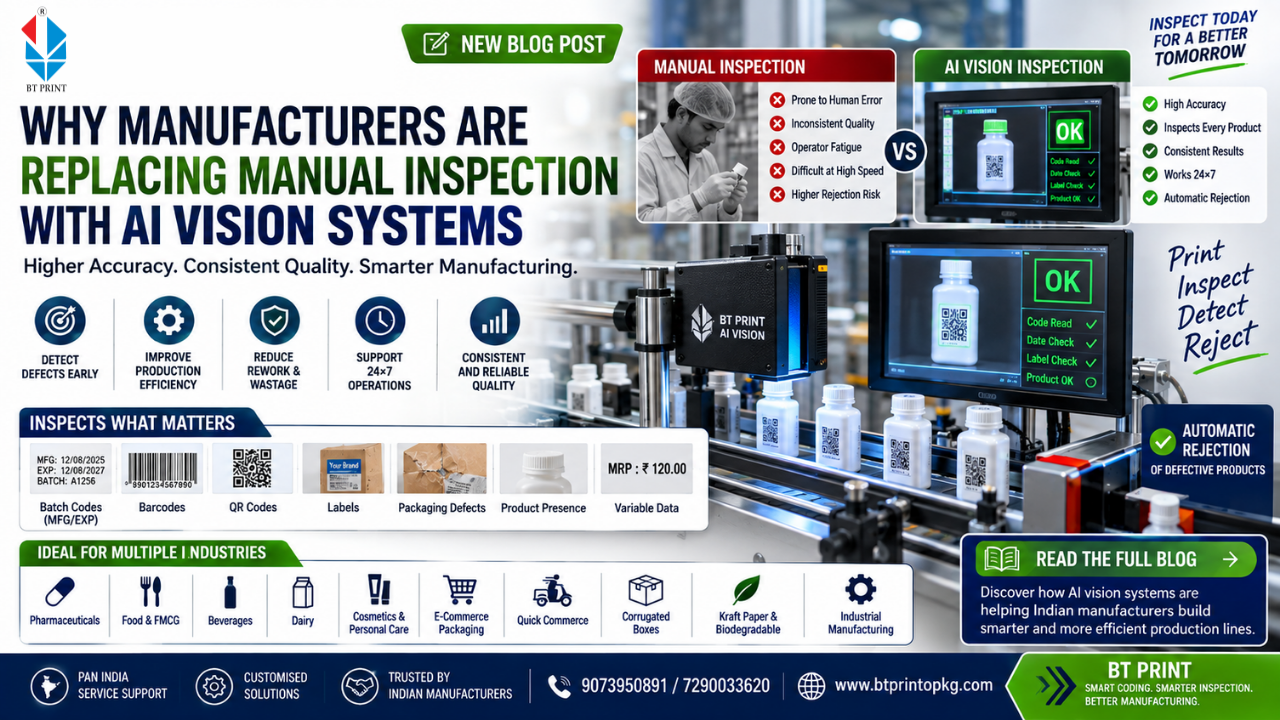
India's manufacturing industry is moving rapidly toward automation. Production lines are becoming faster, product varieties are increasing, and customers expect consistent quality with fewer defects. In this environment, relying entirely on manual inspection is becoming difficult for many manufacturers.
Manual inspection still has an important role in manufacturing, but checking every product visually—especially on a high-speed or 24×7 production line—can be challenging. Operators can become tired, miss small defects, or interpret quality standards differently. This is one reason manufacturers are increasingly considering an AI Vision Inspection System for automated quality control.
What Is an AI Vision Inspection System?
An AI Vision Inspection System uses industrial cameras, lighting, image processing and intelligent software to inspect products automatically.
Instead of depending on an operator to look at every item, the system captures images as products move through the production line and checks them against predefined inspection parameters.
Depending on the application, an AI vision system can inspect:
- Batch codes
- MFG and EXP dates
- Barcodes
- QR codes
- Labels
- Product presence
- Packaging defects
- Missing or damaged components
- Print quality
- Incorrect information
The system can identify a defective product and, when connected to a suitable rejection mechanism, automatically remove it from the production line.
This creates a simple automated process:
PRINT → INSPECT → DETECT → REJECT
Why Is Manual Inspection Becoming Difficult?
Consider an Indian factory producing thousands of packages every hour. An operator may need to check whether the batch number is correct, whether the expiry date is readable, whether the barcode is present and whether the packaging is damaged.
Doing this continuously for several hours is not easy.
The main challenges of manual inspection include:
1. Human Fatigue
Repetitive inspection can cause fatigue, particularly during long shifts. A small printing defect that is easy to notice at the beginning of a shift may be harder to identify after several hours.
2. High Production Speed
Modern packaging lines can move products very quickly. At higher speeds, manually checking every product becomes increasingly difficult.
3. Inconsistent Inspection
Different operators may have different levels of attention and experience. This can result in variations in inspection quality.
4. Increasing Product Variety
Indian manufacturers are producing more SKUs and packaging variations. Checking different labels, codes and product formats manually can become complicated.
5. 24×7 Manufacturing
Many industries operate multiple shifts or continuous production. Maintaining the same level of manual inspection throughout the day and night can be challenging.
AI-based inspection helps address these challenges by providing automated and repeatable inspection.
How AI Vision Inspection Works
The basic working process is straightforward.
Step 1: Product Moves on the Production Line
The product passes through a conveyor or production system.
Step 2: Camera Captures the Product
An industrial camera captures an image of the product or packaging.
Step 3: AI Software Analyses the Image
The system analyses the captured image based on predefined inspection requirements.
Step 4: Defect Is Detected
If the system finds a missing, incorrect or defective element, it identifies the product as a reject.
Step 5: Automatic Rejection
When integrated with a suitable reject mechanism, the defective product can be automatically removed.
This allows manufacturers to inspect products without stopping the production line.
AI Vision for Batch Code Verification
One of the most practical applications for Indian manufacturers is batch code inspection.
Manufacturers often print batch numbers, manufacturing dates and expiry dates using a Batch Coding Machine, TIJ Printer or CIJ Printer.
But printing the information is only the first step.
A manufacturer also needs to know:
Was the code printed?
- Is it readable?
- Is the correct information being printed?
- Is the code positioned correctly?
An AI Vision Inspection System can be used to verify these parameters for suitable applications.
For example, if a packaging line prints an expiry date and one product receives a missing or incorrect print, the vision system can detect the issue and trigger rejection.
This can significantly reduce the risk of defective coded products moving further down the production line.
Barcode and QR Code Inspection
Barcodes and QR codes are increasingly important in Indian manufacturing, logistics and packaging.
They can be used for product identification, traceability, inventory management and supply-chain processes.
However, a barcode that looks acceptable to the human eye may not always scan correctly.
An automated vision system can check the presence and quality of printed codes based on the application's inspection requirements.
This is especially useful for high-volume production where manually checking every barcode or QR code is impractical.
Pharmaceutical Industry
The pharmaceutical industry is one of the strongest applications for automated inspection.
Pharmaceutical packaging may require critical information such as:
- Batch number
- Manufacturing date
- Expiry date
- MRP
- Barcode
- QR code
- Product information
- Variable identification data
A missing or incorrect code can create serious quality and traceability concerns.
For this reason, pharmaceutical manufacturers can benefit from combining a reliable Batch Coding Printer with automated vision inspection.
The printer produces the required information, while the vision system verifies it.
For high-volume pharmaceutical packaging lines, this can provide an additional layer of quality control.
FMCG and Food Packaging
FMCG and food manufacturers also deal with large production volumes and frequent SKU changes.
Products may require batch numbers, MFG/EXP dates, MRP, barcodes and other variable information.
An AI inspection system can help manufacturers check packaging and coding automatically while products move through the line.
Potential applications include:
- Packaged food
- Snacks
- Beverages
- Dairy products
- Personal care products
- Household products
The exact inspection capability depends on the product, camera configuration and software setup.
E-Commerce and Quick Commerce Packaging
India's e-commerce and quick commerce sectors are creating new requirements for packaging manufacturers.
Large quantities of:
- Corrugated boxes
- Courier bags
- Kraft paper bags
- Biodegradable bags
- Shipping packages
- Food delivery packaging
are being produced every day.
These packages may contain barcodes, QR codes, product identification and other variable information.
At high production volumes, manual inspection can become difficult.
An AI Vision Inspection System can help manufacturers automatically verify printed information and packaging quality before products leave the production line.
For e-commerce packaging suppliers, this can be particularly valuable because a printing error can affect scanning, sorting, inventory management or delivery operations.
AI Vision + Coding Machine: A Powerful Combination
AI vision inspection becomes even more useful when integrated with industrial coding equipment.
For example:
BT Print TIJ Printer → AI Vision Inspection → Automatic Reject
The TIJ Printer prints the required information.
The AI vision system checks the print.
If the information does not meet the configured inspection criteria, the defective product can be rejected automatically.
The same concept can be applied with a CIJ Printer, TTO Printer or other suitable coding technology.
This turns coding from a simple printing operation into a more controlled quality process.
Reducing Rework and Packaging Waste
A coding mistake discovered after packaging has already left the production line can be expensive to correct.
The manufacturer may have to:
- Stop production
- Identify affected products
- Rework packages
- Replace packaging
- Dispose of defective products
- Handle customer complaints
Detecting the problem immediately after printing can help reduce these downstream costs.
Automated inspection can therefore contribute to better production efficiency and potentially reduce unnecessary rework and waste.
Supporting 24×7 Production
For factories operating 24×7, automation becomes even more valuable.
An AI vision system can continuously inspect products while the production line is running.
This does not mean human operators become unnecessary. Instead, their role can shift from manually checking every product to managing the automated inspection process, responding to exceptions and maintaining the production system.
This combination of automation + human supervision can create a more practical quality-control model for modern factories.
What Should Indian Manufacturers Consider Before Buying?
AI vision systems are not one-size-fits-all. Before selecting a solution, manufacturers should evaluate:
Production Speed
The camera and processing system must be suitable for the actual line speed.
Product Material
The surface, colour, shape and reflectivity of the product can affect camera and lighting requirements.
Inspection Requirement
Clearly define whether you need code verification, label inspection, product inspection or multiple checks.
Lighting
Correct industrial lighting is essential for reliable image capture.
Integration
The vision system may need to communicate with the printer, conveyor, PLC, sensor and reject mechanism.
Product Variations
If the factory produces multiple SKUs, the system should be evaluated for format and recipe management.
Reject Mechanism
For automatic rejection, the system needs to be properly integrated with the production line.
Where AI Vision Inspection Can Be Used
The technology has applications across several Indian manufacturing sectors, including:
- Pharmaceuticals
- Food & FMCG
- Beverages
- Dairy
- Cosmetics & Personal Care
- E-Commerce Packaging
- Quick Commerce Packaging
- Corrugated Box Manufacturing
- Kraft Paper Packaging
- Biodegradable Packaging
- Electronics
- Automotive Components
- Industrial Manufacturing
Each application requires a different inspection setup, so manufacturers should conduct application testing before finalising the system.
Why Choose BT Print AI Vision Inspection?
BT Print provides AI Vision Inspection Systems for suitable manufacturing and packaging applications across India.
Our solutions can be designed for applications involving:
- Batch code verification
- MFG/EXP inspection
- Barcode inspection
- QR code inspection
- OCR/OCV inspection
- Label inspection
- Packaging inspection
- Defect detection
- Automatic rejection
BT Print also provides a complete range of Industrial Coding Solutions, including TIJ Printers, CIJ Printers, TTO Printers, Laser Marking Machines, Batch Coding Machines and related automation solutions.
This allows manufacturers to consider coding and inspection together rather than treating them as completely separate processes.
Conclusion
Manufacturing quality is becoming increasingly important in India. As production speeds increase and factories move toward automation, manually inspecting every product becomes more challenging.
An AI Vision Inspection System can provide continuous, consistent and automated inspection of suitable products and packaging.
From pharmaceutical batch codes and FMCG packaging to e-commerce boxes, quick commerce bags, barcodes and QR codes, AI vision technology can help manufacturers identify problems earlier and reduce the chances of defective products moving forward.
The most effective setup is often not simply a camera placed beside a production line. It is a properly integrated system where coding, inspection and rejection work together.
Print → Inspect → Detect → Reject.
For Indian manufacturers looking to improve quality control, reduce rework and build more automated production lines, AI vision inspection is becoming an increasingly practical technology to consider.
BT Print — Smarter Coding. Smarter Inspection. Better Manufacturing.