The manufacturing industry is evolving faster than ever. With increasing customer expectations, stricter quality regulations, and the demand for zero-defect products, manufacturers can no longer rely solely on manual quality inspection. Whether it's pharmaceuticals, food, beverages, cosmetics, FMCG, or industrial products, every product leaving the factory must meet the highest quality standards.
At the same time, production lines are becoming faster. A modern packaging line can produce hundreds of products every minute, making manual inspection nearly impossible. Even the most experienced operator can miss small defects after inspecting thousands of products during a shift.
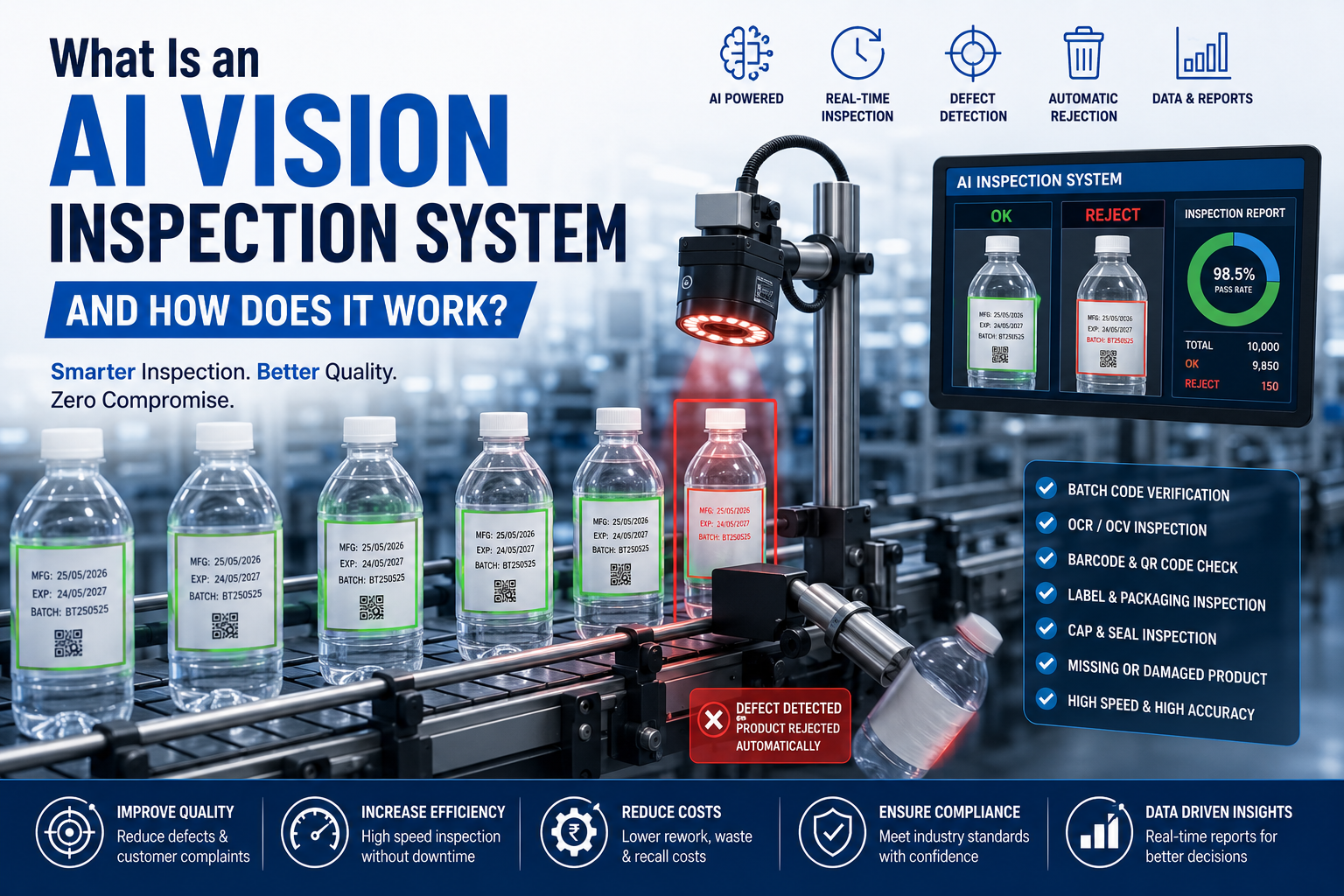
This is where an AI Vision Inspection System plays a crucial role. By combining artificial intelligence, high-speed industrial cameras, machine learning, and automated reject mechanisms, manufacturers can inspect every product in real time without slowing production.
In this blog, we'll explain what an AI Vision Inspection System is, how it works, where it is used, and why it is becoming an essential part of modern manufacturing in India.
What Is an AI Vision Inspection System?
An AI Vision Inspection System is an intelligent quality inspection solution that uses industrial cameras and Artificial Intelligence (AI) to inspect products automatically on a production line.
Unlike conventional vision systems that follow fixed programming rules, AI-powered inspection systems continuously learn from thousands of images. They can recognize acceptable product variations while accurately identifying defects that traditional inspection systems may overlook.
The system captures images of every product, analyses them within milliseconds, makes an inspection decision, and automatically removes defective products before they reach the customer.
When integrated with a Batch Coding Machine, manufacturers not only print product information but also verify that every code is accurate and readable before dispatch.
How Does an AI Vision Inspection System Work?
Although the technology is advanced, the working process is quite simple.
Step 1: Image Capture
- As products move along the conveyor, high-speed industrial cameras capture images from one or multiple angles.
- Specialized LED lighting ensures clear image quality even at high production speeds.
- Depending on the application, the system may inspect bottles, cartons, pouches, labels, caps, blister packs, or finished products.
Step 2: AI-Based Image Analysis
- The captured images are instantly analysed using Artificial Intelligence and deep learning algorithms.
- Instead of simply comparing one image with another, AI understands what a correct product should look like.
- It can detect even the smallest defects, including:
- Incorrect batch codes
- Missing manufacturing or expiry dates
- Unreadable text
- Wrong labels
- Missing products
- Damaged packaging
- Incorrect cap placement
- Broken seals
- Barcode and QR code printing errors
- Product orientation issues
Since AI continuously learns from inspection data, its accuracy improves over time, reducing unnecessary product rejection.
Step 3: Automatic Pass or Fail Decision
- After inspection, the AI system immediately decides whether the product meets all quality standards.
- Products that pass continue on the production line without interruption.
- If any defect is detected, the system instantly sends a signal to an automatic reject mechanism.
Step 4: Automatic Product Rejection
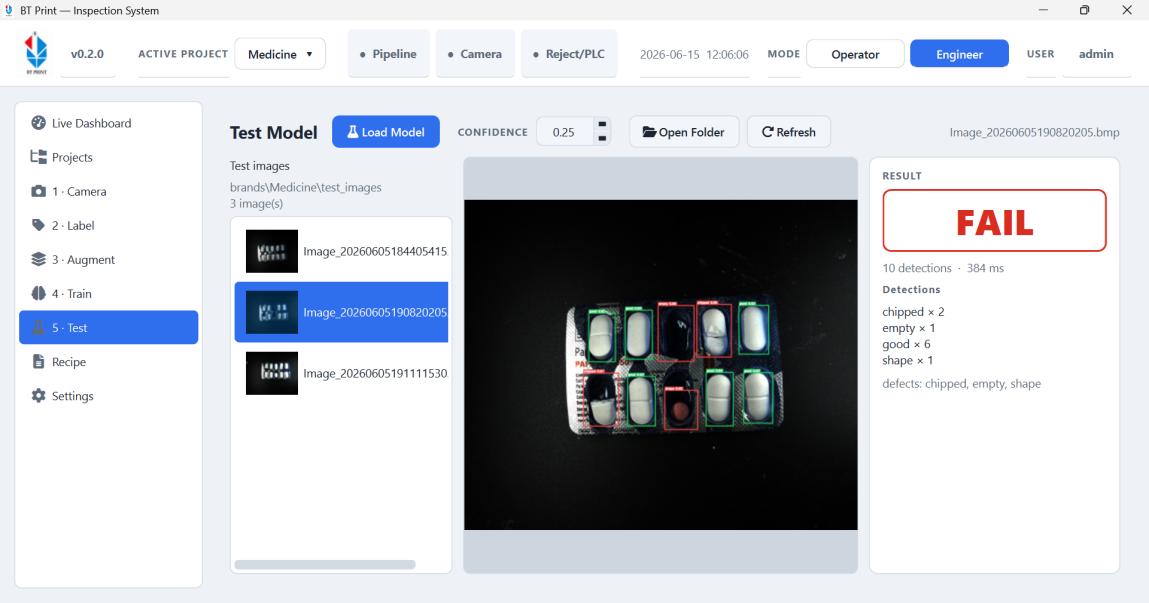
One of the biggest advantages of an AI Vision Inspection System is that it does much more than simply detect defects—it automatically removes defective products from the production line.
Depending on the application, the reject mechanism may use:
- Pneumatic Air Blower
- Pneumatic Pusher
- Servo Reject System
- Swing Arm Rejector
- Flipper Reject Mechanism
- Conveyor Diverter
As soon as a defect is identified, the faulty product is automatically rejected without any manual intervention.
This ensures that only approved products move forward for packing and dispatch, helping manufacturers reduce customer complaints, recalls, and production losses.
Step 5: Data Collection and Reporting
Every inspection generates valuable production data.
Manufacturers can monitor:
- Inspection reports
- Defect trends
- Machine efficiency
- Rejection percentage
- Production statistics
- Product traceability
This information helps improve production quality and supports continuous process improvement.
What Can an AI Vision Inspection System Detect?
Modern AI inspection systems are capable of performing multiple quality checks simultaneously.
Batch Code Verification
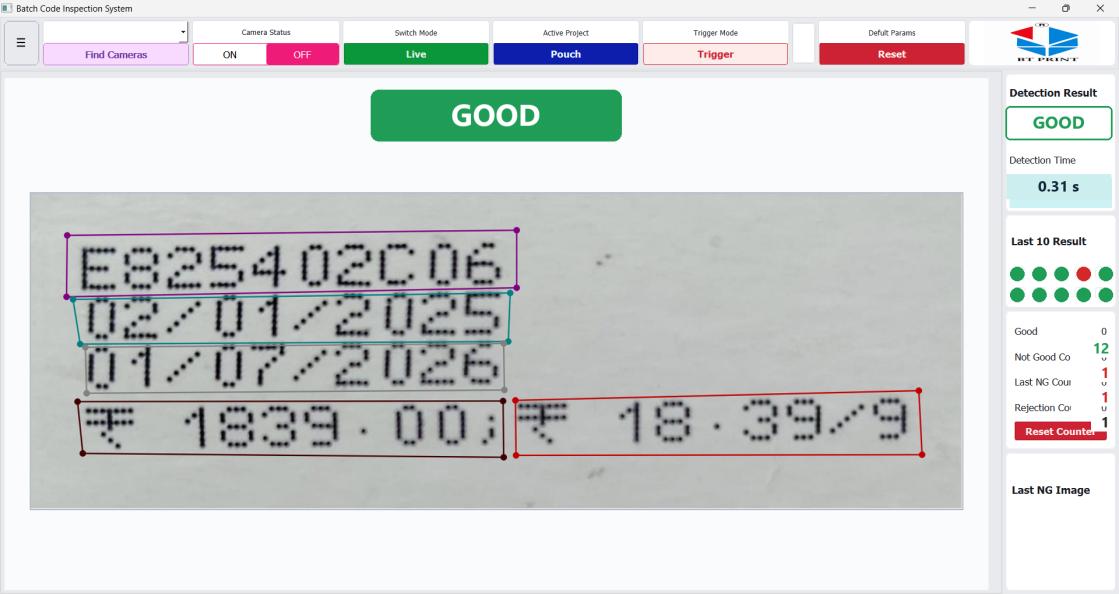
The system verifies batch number, manufacturing date, expiry date, MRP, and lot number printed using a Batch Coding Machine, CIJ Printer, TIJ Printer, or Laser Marking Machine.
Even partially printed or faded codes can be detected before products leave the factory.
OCR and OCV Inspection
Optical Character Recognition (OCR) allows the system to read printed characters.
Optical Character Verification (OCV) checks whether the printed information matches the expected data.
This is especially useful in pharmaceutical, food, and beverage manufacturing.
Barcode and QR Code Inspection
The system verifies:
- 1D Barcodes
- QR Codes
- Data Matrix Codes
- Serial Numbers
It also checks whether the codes are readable and scannable.
Label Inspection
Incorrect labels can result in costly product recalls.
AI inspection verifies:
- Label presence
- Label position
- Label alignment
- Label accuracy
- Label damage
- Cap Inspection
For beverage and packaged drinking water manufacturers, cap inspection is essential.
The system checks:
- Cap presence
- Cap alignment
- Cap colour
- Proper sealing
- Loose caps
- Packaging Inspection
AI systems can inspect:
- Damaged cartons
- Torn pouches
- Missing products
- Seal defects
- Incorrect packaging
- Product orientation
All these inspections happen within milliseconds.
Industries That Use AI Vision Inspection Systems
Pharmaceutical Industry
Pharmaceutical companies use AI inspection to verify:
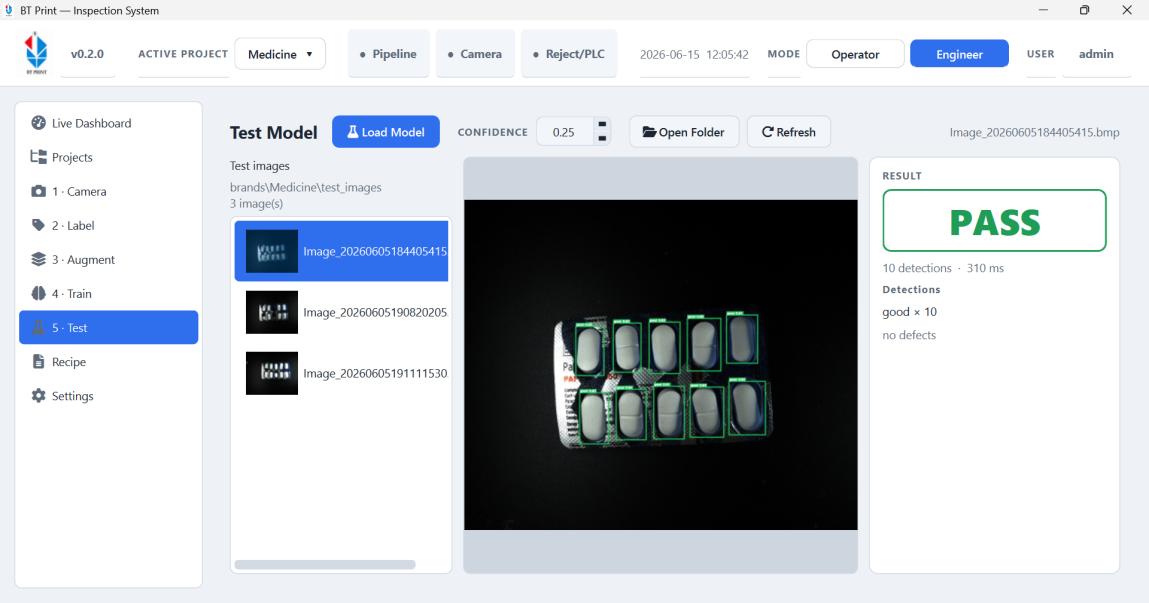
- Batch codes
- Expiry dates
- Blister packs
- Labels
- Tablets
- Cartons
- Serialization codes
This improves compliance and product traceability.
Food Industry
Food manufacturers inspect:
- Packaging quality
- Seal integrity
- Batch codes
- Product presence
- Label accuracy
This reduces food safety risks and improves customer confidence.
Packaged Drinking Water Industry
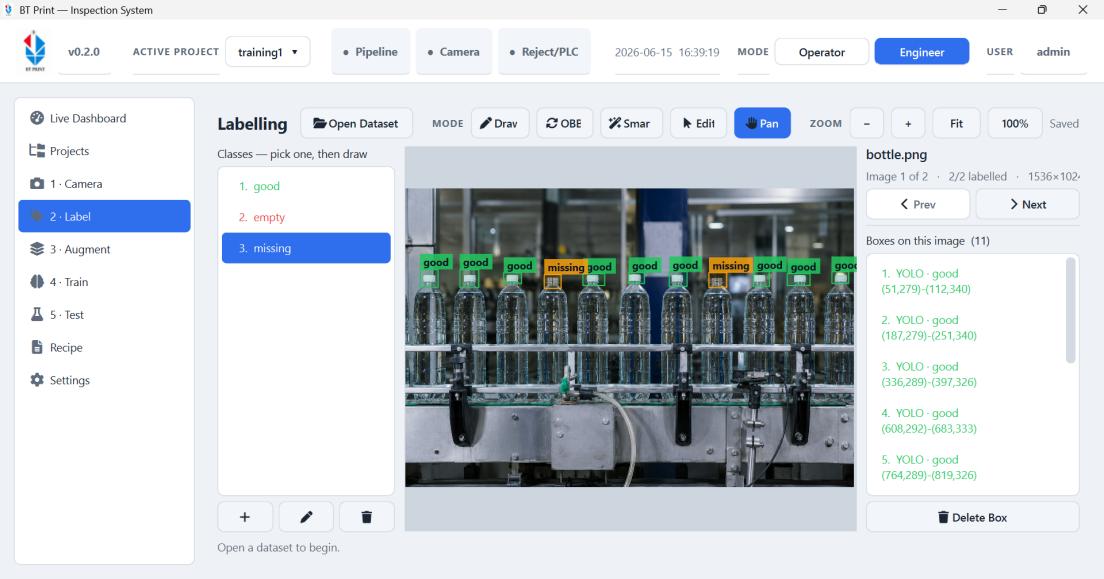
Water manufacturers use AI systems to inspect:
- Bottle caps
- Bottle labels
- Fill levels
- Manufacturing dates
- Expiry dates
- Batch numbers
High-speed inspection helps maintain consistent product quality even on fast bottling lines.
Cosmetics Industry
Cosmetic manufacturers inspect:
- Labels
- Caps
- Packaging
- Batch codes
- Product appearance
Premium cosmetic brands particularly benefit because packaging quality directly influences customer perception.
FMCG Industry
AI inspection is widely used for:
- Flexible packaging
- Cartons
- Bottles
- Jars
- Pouches
- Cans
The technology ensures every product leaving the production line meets quality standards.
Benefits of AI Vision Inspection Systems
- Improved Product Quality
- Every product is inspected consistently, ensuring high quality and reducing defective products.
- Reduced Human Error
- Unlike manual inspection, AI never becomes tired or distracted.
- Higher Production Speed
- Products are inspected in real time without affecting production speed.
- Automatic Defect Removal
- Defective products are automatically rejected before packing, reducing manual inspection work.
- Better Traceability
- When integrated with Industrial Coding Solutions, manufacturers gain complete visibility across the production process.
- Lower Product Recalls
- Detecting defects before dispatch significantly reduces customer complaints and recall costs.
- Improved Compliance
- AI inspection helps manufacturers meet quality and regulatory requirements in food, pharmaceutical, beverage, and cosmetic industries.
AI Vision Inspection and Batch Coding: A Perfect Combination
Printing accurate information is only half the job. The real challenge is ensuring that every printed code is correct and readable.
This is why many manufacturers combine AI inspection with:
The coding equipment prints the required information, while the AI Vision Inspection System verifies every product in real time and automatically rejects any product with incorrect or unreadable information.
This combination greatly improves production efficiency while reducing waste and ensuring complete product traceability.
Why AI Vision Inspection Is the Future of Manufacturing
Manufacturing is rapidly moving toward Industry 4.0, where automation, artificial intelligence, and real-time data are driving smarter production.
AI Vision Inspection Systems support this transformation by offering:
- Intelligent quality inspection
- Automatic product rejection
- Production analytics
- Real-time monitoring
- Predictive quality control
- Smart factory integration
As labour shortages, production volumes, and quality expectations continue to rise, AI-powered inspection is becoming a necessity rather than an option.
Why Choose BT Print for AI Vision Inspection Solutions?
BT Print provides advanced inspection and coding solutions designed to improve quality, compliance, and production efficiency across industries.
Our product portfolio includes:
- AI Vision Inspection System
- End-of-Line Inspection System
- Batch Coding Machine
- CIJ Printer
- TIJ Printer
- TTO Printer
- Laser Marking Machine
Our solutions are suitable for pharmaceutical, food, beverage, packaged drinking water, dairy, cosmetics, FMCG, chemical, and industrial manufacturing applications. With expert consultation, installation, operator training, and pan-India service support, BT Print helps manufacturers build smarter and more reliable production lines.
Conclusion
An AI Vision Inspection System is no longer just an advanced technology—it has become a practical investment for manufacturers who want to improve product quality, reduce defects, and automate quality control. By combining high-speed cameras, artificial intelligence, and automatic reject mechanisms, these systems inspect every product with speed and accuracy that manual inspection simply cannot match.
When integrated with Batch Coding Machines, CIJ Printers, TIJ Printers, TTO Printers, and Laser Marking Machines, AI inspection creates a complete quality assurance solution. It ensures that every batch code, label, barcode, QR code, and package is verified before leaving the production line.
As Indian manufacturers continue adopting Industry 4.0 and smart factory technologies, AI Vision Inspection Systems will play a vital role in achieving higher productivity, stronger compliance, improved traceability, and zero-defect manufacturing. Investing in the right inspection solution today will help businesses stay competitive and deliver consistent quality in the years ahead.