In today's manufacturing environment, product traceability has become more important than ever. Whether you are producing pharmaceuticals, food products, cosmetics, beverages, electronics, or consumer goods, the ability to identify and track products throughout the supply chain is critical for compliance, quality control, and consumer safety.
Two terms that are frequently used in product identification are Batch Coding and Serialization. While both technologies help manufacturers track products, they serve different purposes and offer different levels of traceability.
Many manufacturers assume that serialization and batch coding are the same thing, but they are not. Understanding the difference can help businesses choose the right solution based on their regulatory requirements, operational needs, and long-term growth plans.
In this article, we explain the difference between serialization and batch coding, their applications, benefits, and how modern Batch Coding Machines, CIJ Printers, TIJ Printers, and Laser Marking Machines support these traceability systems.
What Is Batch Coding?
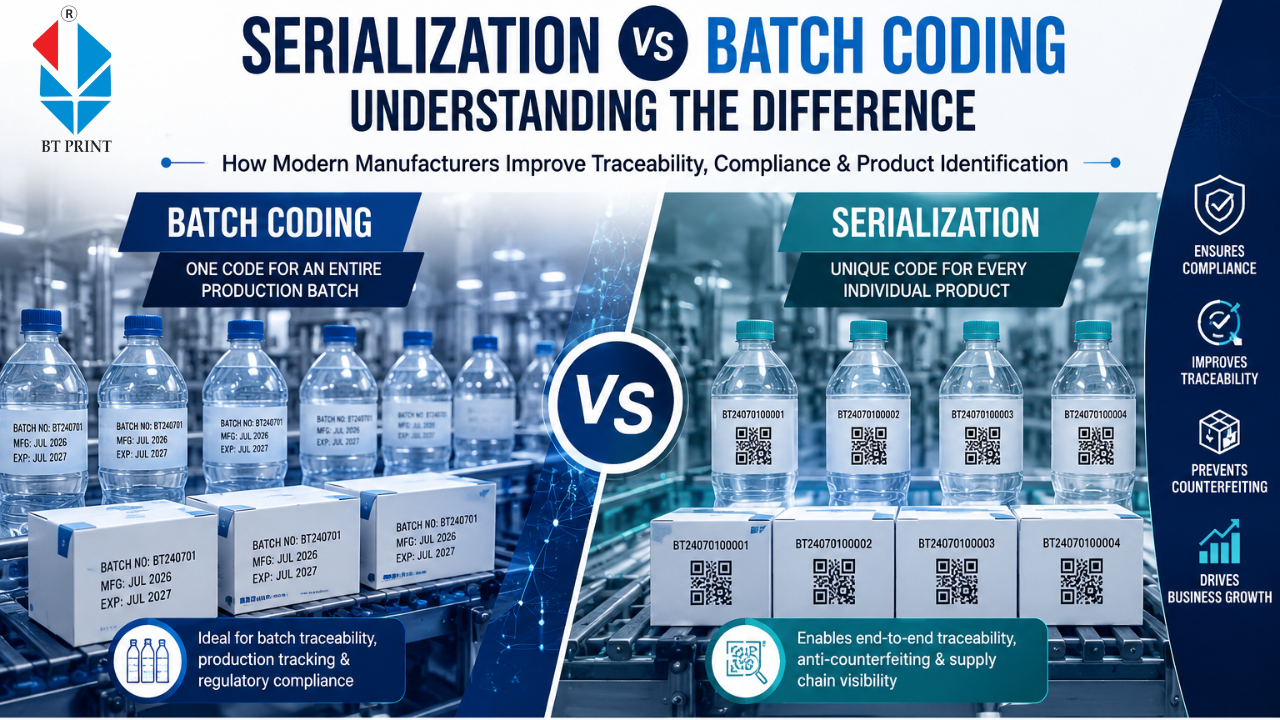
Batch coding is the process of printing the same information on a group of products manufactured under similar conditions.
A typical batch code may include:
* Batch number
* Manufacturing date
* Expiry date
* Shift code
* Plant code
* MRP
For example, if a dairy company produces 20,000 milk pouches during a single production run, all pouches may carry the same batch number and manufacturing date.
Batch coding is one of the most common requirements across industries and is typically achieved using a **Batch Coding Machine** or Batch Coding Printer.
Why Batch Coding Is Important
Batch coding helps manufacturers:
* Meet regulatory requirements
* Track production lots
* Manage recalls efficiently
* Improve inventory management
* Ensure product authenticity
Industries commonly using batch coding include:
* Food & Beverage
* Packaged Drinking Water
* Dairy
* Pharmaceuticals
* Cosmetics
* Chemicals
* Lubricants
* FMCG Products
A reliable CIJ Printer or TIJ Printer is often used to print batch information on bottles, cartons, pouches, labels, and caps.
What Is Serialization?
Serialization takes traceability a step further.
Instead of assigning the same code to an entire production batch, serialization gives each individual product a unique identification number.
For example:
Bottle 1 → 123456789
Bottle 2 → 123456790
Bottle 3 → 123456791
Each product receives its own unique identity.
This information is usually encoded within:
* QR Codes
* Data Matrix Codes
* Barcodes
* Alphanumeric Codes
Serialization allows manufacturers to track a product throughout its entire lifecycle—from production and warehousing to distribution and retail sale.
Why Serialization Is Becoming More Important
Global supply chains are becoming increasingly complex. Governments and regulatory bodies are demanding higher levels of product traceability to combat:
* Counterfeiting
* Product diversion
* Grey market activities
* Supply chain fraud
Serialization enables businesses to verify the authenticity of each individual product.
This is especially important in industries such as:
* Pharmaceuticals
* Medical Devices
* Electronics
* Luxury Goods
* High-Value Consumer Products
The Key Difference Between Batch Coding and Serialization
The simplest way to understand the difference is:
Batch Coding
All products within a production batch carry the same code.
Example:
Batch No: BT240701
All 10,000 bottles share this code.
Serialization
Every product receives its own unique identifier.
Example:
BT24070100001
BT24070100002
BT24070100003
Every bottle has a different code.
Batch coding identifies a group of products.
Serialization identifies individual products.
Batch Coding vs Serialization: Which Is Better?
The answer depends on your industry requirements.
Batch coding is sufficient when:
* Regulations require batch traceability only.
* Product recall management is based on batches.
* Product value is relatively low.
* Production volumes are extremely high.
Serialization becomes necessary when:
* Product authentication is required.
* Counterfeit prevention is important.
* Individual product tracking is needed.
* Regulatory requirements mandate serialization.
For many Indian manufacturers, batch coding remains the primary requirement. However, serialization is gaining popularity, particularly in pharmaceutical and export-oriented industries.
Technologies Used for Batch Coding
Several coding technologies support batch coding operations.
CIJ Printers
A CIJ Printer is one of the most widely used solutions for batch coding.
It is ideal for:
* PET Bottles
* Glass Bottles
* Plastic Containers
* Metal Cans
* Flexible Packaging
A Continuous Inkjet Printer offers high-speed, non-contact printing, making it suitable for fast production lines.
TIJ Printers
A TIJ Printer provides high-resolution coding on:
* Cartons
* Labels
* Corrugated Boxes
* Paper Packaging
It is commonly used for secondary packaging applications.
---
TTO Printers
A TTO Printer is designed for:
* Flexible Packaging
* Laminates
* Pouches
* Shrink Films
It delivers sharp and durable prints on packaging films.
Laser Marking Machines
A Laser Marking Machine offers permanent coding without ink or solvents.
It is increasingly used for:
* Pharmaceutical Packaging
* Beverage Bottles
* Cosmetic Products
* Plastic Components
* Packaging Films
Laser systems can handle both batch coding and serialization applications.
Technologies Used for Serialization
Serialization requires more than just a printer.
A complete serialization solution includes:
* Variable Data Software
* Database Management System
* Barcode or QR Code Generation
* Vision Inspection System
* Product Tracking Software
Modern Industrial Coding Solutions integrate coding hardware with software systems to manage serialization data efficiently.
The Role of QR Codes in Serialization
One of the biggest trends in manufacturing today is the use of QR codes.
Serialized QR codes can store:
* Product identity
* Manufacturing information
* Supply chain data
* Authentication records
Many manufacturers are adopting QR code-based traceability to improve consumer engagement and combat counterfeit products.
Advanced Laser Marking Machines and TIJ Printers are capable of printing high-quality QR codes suitable for serialization.
Future of Product Traceability
The future of manufacturing is moving toward smarter and more connected production systems.
Emerging trends include:
* Industry 4.0 Integration
* Smart Packaging
* Digital Product Passports
* Blockchain-Based Traceability
* AI-Powered Quality Control
As these technologies become more common, serialization will continue to grow in importance.
However, batch coding will remain essential because it forms the foundation of product identification.
How BT Print Supports Modern Traceability Solutions
At BT Print, we provide advanced coding and marking solutions designed to support both batch coding and serialization requirements.
Our product portfolio includes:
- Batch Coding Machines
- Batch Coding Printers
- CIJ Printers
- Continuous Inkjet Printers
- TIJ Printers
- TTO Printers
- Laser Marking Machines
Our experts help manufacturers choose the right technology based on production speed, packaging material, compliance requirements, and future scalability.
Conclusion
Batch coding and serialization are both essential tools for modern manufacturing, but they serve different purposes.
Batch coding helps manufacturers track production lots and comply with labeling regulations, while serialization provides unique identification for every individual product.
As supply chains become more sophisticated and traceability requirements increase, manufacturers must evaluate which approach best suits their business.
Whether you need a high-speed CIJ Printer, a high-resolution TIJ Printer, a flexible packaging TTO Printer, or a permanent Laser Marking Machine, BT Print offers reliable solutions to support your traceability goals.
Investing in the right coding technology today will help prepare your business for the future of manufacturing tomorrow.