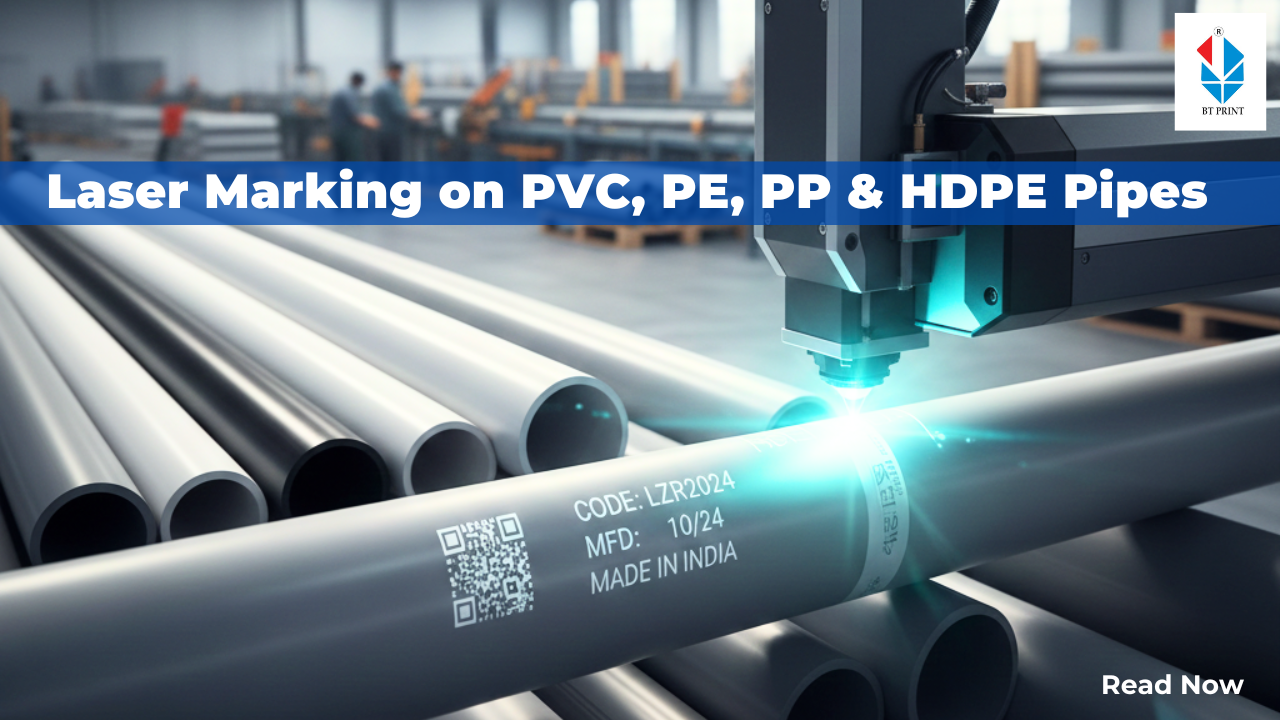
In India’s fast-growing infrastructure and manufacturing sectors, plastic pipes made of PVC, PE, PP, and HDPE are everywhere — from water supply and irrigation to sewage, industrial fluid transport, and gas distribution. With increased demand comes greater need for traceability, brand protection, and regulatory compliance. One critical tool that has emerged for achieving all of this is laser marking technology.
Laser marking offers clean, permanent, non-contact printing directly on pipe surfaces, without consumables like ink or solvents. For Indian manufacturers, this not only improves production efficiency but also enhances product traceability throughout the supply chain.
In this blog, we explain the fundamentals of laser marking on PVC, PE, PP, and HDPE pipes, common challenges, best practices, and how modern contactless marking systems are transforming pipe manufacturing.
Why Mark Plastic Pipes?
Before diving into technology, it’s important to understand why marking plastic pipes is essential.
Manufacturers often need to print:
- Manufacturer name or logo
- Pipe size and SDR rating
- Material type (PVC/PE/PP/HDPE)
- Batch/lot number
- Date of manufacture
- Certification marks
- QR codes or traceability data
These markings serve multiple purposes:
- Regulatory Compliance: Pipes for potable water, gas, or industrial use must carry traceable markings.
- Brand Protection: Clear, permanent markings prevent counterfeiting.
- Traceability: Marking helps track production batches and manage quality control errors.
- Customer Confidence: Legible, durable codes improve trust on the retail shelf.
To achieve consistent and permanent markings on plastics, many Indian manufacturers are now upgrading from traditional printing to laser marking machines.
How Laser Marking Works on Plastic Pipes
Laser marking uses a highly focused beam of light to create marks by altering the surface of the material. There is no physical contact — the laser simply heats, foams, or engraves the surface. This makes it ideal for smooth and curved pipe materials without damaging the structural integrity.
Depending on the pipe material and the desired mark effect, different laser types may be used:
CO2 Laser (Best for PVC & HDPE)
CO2 lasers are commonly used for plastics like PVC and HDPE. They create high-contrast marks by vaporizing or foaming the surface layer.
- Ideal for PVC
- Good contrast on HDPE
- Works well on larger diameters
Fiber Laser (Best for PE & PP)
Fiber lasers deliver high energy in short pulses, allowing for precise control. They work well on PE and PP by altering the surface without cracking or deforming the plastic.
- Fine detail marking
- Stable even at high speeds
- Long-lasting performance
UV Laser (Great for Thin Films & Additives)
UV lasers are lower heat and produce minimal thermal stress, making them suitable if pipes contain additives or special coatings.
- Minimal heat effect
- Incredible precision
- Ideal for high-definition marking
Why Laser Marking Beats Traditional Coding Methods
Historically, manufacturers used inkjet CIJ printers or sticker labeling on pipes. These methods have several downsides:
- Ink may smudge or fade in sunlight or during transport
- Sticker labels can fall off over time
- Repeated maintenance and consumables increase cost
- Manual alignment slows down production lines
Laser marking overcomes these by:
- Creating permanent, tamper-proof marks
- Eliminating ink, solvents, and consumables
- Supporting high-speed, automated production
- Reducing ongoing operating costs
For Indian pipe manufacturers who face high throughput demands, contactless marking has become a strategic advantage
Common Challenges in Marking Plastic Pipes
Although laser marking is highly effective, Indian manufacturers must be aware of a few challenges when marking plastic pipes:
1. Surface Reflectivity
Pipes with shiny or reflective surfaces can scatter laser energy, leading to inconsistent marks. Choosing the right laser type (e.g., UV or fiber) helps overcome this.
2. Material Additives
Some polymers contain UV stabilizers or colorants that affect the way the laser interacts with the surface. Material testing before full integration helps optimise settings.
3. Curved Surfaces & Pipe Diameters
Curved or large-diameter pipes require laser systems with adjustable focus and motion control to ensure uniform printing along the circumference.
Automated fixtures and vision systems maintain accuracy across diverse products.
4. Production Speed Compatibility
High-speed extrusion and printing lines demand laser systems that can mark without slowing production. Choosing a laser with high pulse frequency and fast scanning optics is crucial.
Best Practices for Laser Marking on Pipes
If you’re planning to upgrade your pipe marking process, consider the following:
Material Testing Before Installation
Always test the specific plastic formulation with the laser system to determine optimum settings and contrast.
Use the Right Laser for the Right Material
PVC vs PE vs PP vs HDPE all interact differently with laser wavelengths. Match material to laser type:
- PVC/HDPE – CO? laser
- PE/PP – Fiber laser
- Additive or specialty – UV laser
Integrate with Automation
Pairing laser marking with conveyor automation ensures consistent speed and positioning without manual adjustment.
For highly efficient lines, use batch coding machines with motion control and feedback sensors.
Consider Environmental Conditions
In pipe extrusion environments, dust, heat, and vibration are common. Industrial-grade laser systems with proper shielding and air filtration improve long-term reliability.
Applications Across Industries
Laser marking on plastic pipes is increasingly popular across multiple Indian sectors:
- Water & Irrigation Systems
- Permanent marking ensures pipe size, pressure rating, and traceability even after years in service.
- Gas Distribution & Industrial Pipes
- Tamper-proof codes help meet safety regulations and simplify maintenance tracking.
- Pharmaceutical & Textile Industries
- High-visibility coding improves batch traceability and audit compliance.
- Infrastructure & Construction
Laser marks remain legible despite exposure to weather and abrasion.
BT Print: Supporting Indian Manufacturers with Laser Solutions
At BT Print, we understand the unique marking needs of Indian pipe manufacturers. Our laser marking machine solutions are designed for:
- Permanent, high-contrast codes
- No consumables or running ink costs
- High-speed production line integration
- Easy automation and maintenance
Whether you’re a PVC extrusion unit in Faridabad, an HDPE pipe maker in Gujarat, or a multi-product facility in Tamil Nadu, we help you choose the right contactless coding system.
Explore our range:
- Continuous Inkjet Printers
- Industrial Laser Marking Machines
- High-Speed Batch Coding Solutions
- Optimised Pipe Marking Systems
Conclusion
Flexible plastic pipe manufacturing demands coding that is fast, permanent, and readable — no matter the surface or speed. Traditional methods are quickly being replaced by laser marking, a technology that delivers reliability, cost savings, and superior quality.
By understanding the interaction between laser types and plastic materials such as PVC, PE, PP, and HDPE, Indian manufacturers can future-proof their production lines and meet global quality standards with confidence.
If your manufacturing unit is facing coding challenges on pipes, laser marking could be your most efficient, long-term solution.
Contact BT Print today to discuss the ideal marking technology for your production needs!
www.btprintopkg.com
9073950891 / 7290033620
sales@btprintopkg.com