In today's competitive manufacturing industry, product quality is not just about what goes inside the package. The information printed on the package is equally important. Batch numbers, manufacturing dates, expiry dates, MRP and product identification codes help customers, distributors and manufacturers identify and track products throughout the supply chain.
However, poor batch coding is still a common challenge across several industries. Faded printing, missing characters, incorrect dates, unreadable batch numbers and inconsistent coding can create serious problems for manufacturers.
For businesses operating in India, particularly in food and beverages, pharmaceuticals, cosmetics, FMCG and packaged consumer goods, accurate batch coding plays an important role in product traceability and quality management.
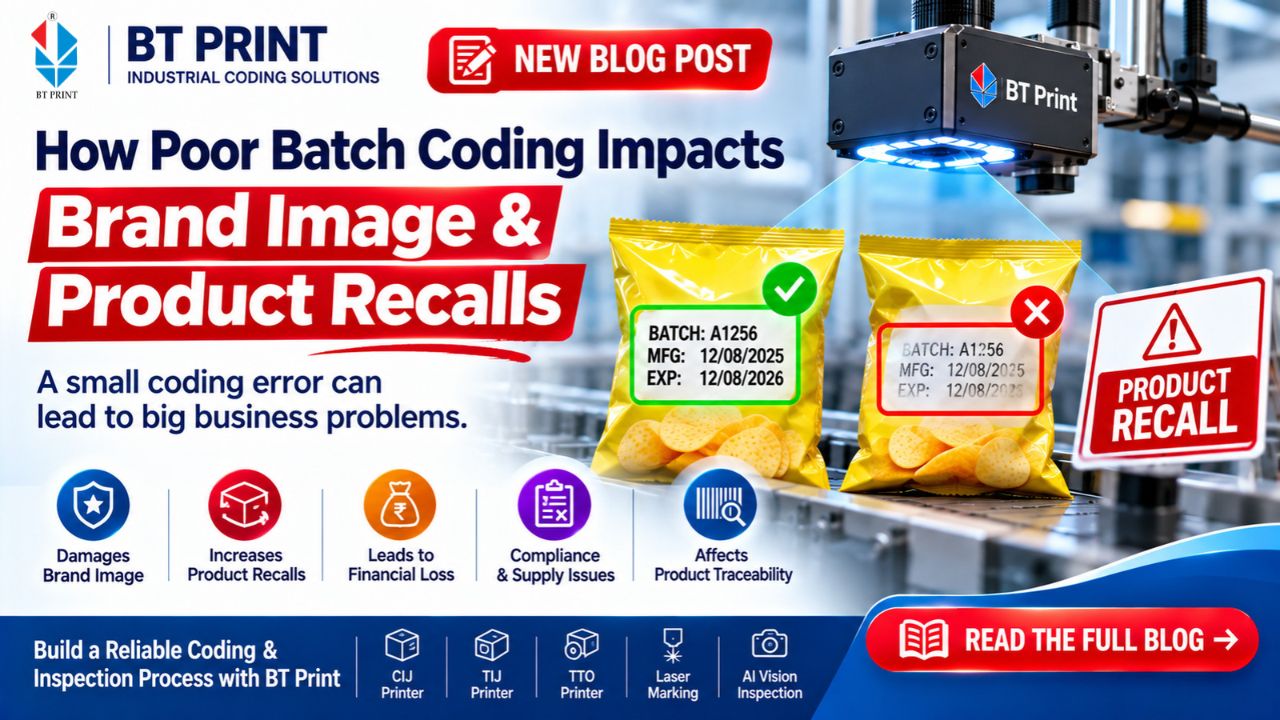
A small coding mistake on a production line can sometimes lead to rejected products, customer complaints, product recalls and damage to brand reputation.
So, how exactly does poor batch coding affect a business, and what can manufacturers do to prevent these problems?
Let's understand.
1. Why Is Batch Coding Important for Manufacturers?
Batch coding is the process of printing unique identification information on product packaging. This information helps manufacturers identify products based on their production batch, manufacturing date and other relevant details.
Common information printed on packaging includes:
- Batch or lot number
- Manufacturing date (MFG)
- Expiry date (EXP)
- Best Before date
- MRP
- Product identification details
- Barcodes and QR codes, where required
For example, if a customer reports a quality issue with a particular packaged food product, the manufacturer can use its batch number to identify the production lot and investigate the issue.
Without clear and accurate batch coding, identifying the affected products becomes much more difficult.
This is why investing in a reliable Batch Coding Machine is an important consideration for manufacturers.
2. How Poor Batch Coding Damages Brand Image
A brand takes years to build, but a few quality-related incidents can affect customer confidence.
Customers expect products to be properly labelled with clear and readable manufacturing and expiry information. When this information is missing or difficult to read, it can create doubts about the product's quality and authenticity.
Let's look at some common situations.
Unreadable Manufacturing and Expiry Dates
Imagine a customer purchasing a packaged drinking water bottle, biscuit packet, dairy product or medicine.
If the expiry date is faded or the manufacturing date is not clearly visible, the customer may hesitate to use the product.
Even if the product itself meets quality requirements, poor printing can create a negative impression.
Incorrect Batch Numbers
An incorrect batch number can make it difficult for manufacturers and distributors to identify a particular production lot.
It can also create confusion during stock management, quality investigations and product traceability activities.
Inconsistent Printing Quality
When some products have clear codes while others have faded, incomplete or misaligned printing, it reflects poorly on packaging quality.
Customers may question the overall manufacturing standards of the company.
Loss of Customer Confidence
Consumers increasingly pay attention to product information, especially when purchasing food, beverages, healthcare products and personal care items.
Repeated coding errors can reduce customer confidence and negatively affect brand loyalty.
3. How Poor Batch Coding Can Lead to Product Recalls
Product recalls are among the most challenging situations for manufacturers. They can involve significant financial costs, operational disruption and reputational damage.
Poor batch coding does not automatically cause a product defect, but it can make a quality incident much harder to manage.
Consider a practical example.
Suppose a packaged food manufacturer identifies a quality issue in one particular production batch. Ideally, the company should be able to identify the affected batch and trace its distribution.
However, if the batch numbers are missing, incorrect or unreadable, identifying the affected products becomes difficult.
The manufacturer may need to investigate a larger quantity of stock or take broader corrective action.
This can increase:
- Product withdrawal and recall costs
- Distributor and retailer coordination efforts
- Product wastage
- Investigation time
- Customer complaints
- Regulatory and compliance-related challenges
Accurate coding supports faster identification of affected products and more targeted recall management.
4. Industries Where Accurate Batch Coding Is Essential
Different industries have different packaging and traceability requirements. However, clear and reliable product coding is important across many manufacturing sectors.
Food and FMCG Industry
Food manufacturers print batch numbers, manufacturing dates, expiry dates and other required information on products such as biscuits, snacks, edible oils, packaged foods and ready-to-eat meals.
Incorrect or unreadable coding can create problems during stock rotation, product identification and quality investigations.
Packaged Drinking Water and Beverages
Bottled water, carbonated drinks, juices and other beverages are manufactured at high speeds.
Manufacturers need reliable coding solutions that can print on compatible bottles, containers and packaging materials without interrupting production unnecessarily.
Pharmaceutical Industry
Pharmaceutical packaging requires accurate product identification and relevant manufacturing and expiry information.
Incorrect or missing coding can create serious traceability and quality-control concerns.
Dairy Industry
Milk packets, yoghurt cups, butter, cheese and other dairy products require clear date and batch information.
Because many dairy products have relatively short shelf lives, accurate coding is particularly important for inventory management and product identification.
Cosmetics and Personal Care
Shampoos, creams, lotions, soaps and other personal care products require suitable product identification and coding.
Poorly printed information can affect packaging presentation and make product identification difficult.
5. Common Reasons Behind Poor Batch Coding
Before choosing a solution, manufacturers should understand why coding problems occur.
Some common reasons include:
1. Incorrect Printer Settings: Wrong print settings, unsuitable character size or incorrect print positioning can affect code quality.
2. Nozzle Blockage: In Continuous Inkjet (CIJ) printers, nozzle-related issues can result in inconsistent printing or missing characters.
3. Poor Maintenance: Lack of regular printer maintenance can lead to recurring coding problems.
4. Unsuitable Ink Selection: Using ink that is not compatible with the packaging material or production environment can result in poor adhesion and reduced print durability.
5. High-Speed Production: Incorrect printer configuration or inadequate synchronisation with the production line can cause incomplete or misplaced codes.
6. Manual Data Entry Errors: Incorrectly entered batch numbers, manufacturing dates or expiry dates can result in inaccurate product information even when the printer is functioning correctly.
Manufacturers should establish proper operating procedures, verify production data and maintain their coding equipment regularly.
6. Choosing the Right Coding Technology to Prevent Printing Problems
Selecting the right coding technology is important for achieving consistent printing quality across different packaging materials and production environments.
BT Print offers several industrial coding and marking solutions for different manufacturing applications.
CIJ Printers – For High-Speed Production Lines
Continuous Inkjet Technology
A CIJ Printer is suitable for high-speed coding applications where manufacturers need to print batch numbers, MFG/EXP dates and other product information on compatible surfaces.
It is widely used in beverage bottles, food packaging, dairy products, cables, pipes and other industrial applications.
TIJ Printers – For High-Resolution Coding
Thermal Inkjet Technology
A TIJ Printer is suitable for applications requiring clear, high-resolution text, barcodes, QR codes and variable information on compatible packaging materials.
BT Print also offers TIJ Printers with Bulk Ink Systems, which can help reduce ink consumption costs by up to 40% in suitable applications, depending on usage and operating conditions.
TTO Printers – For Flexible Packaging
Thermal Transfer Overprinting
A TTO Printer is commonly used for printing variable information on compatible flexible packaging films.
It is suitable for applications such as snack packets, food pouches and other flexible packaging products.
Laser Marking Machines – For Permanent Marking
Industrial Laser Technology
A Laser Marking Machine can create permanent marks on suitable packaging materials and product surfaces.
Depending on the material and application, manufacturers can consider Fiber, CO2 and UV laser marking technologies.
The appropriate solution depends on the substrate, marking requirements and production conditions.
7. Why AI Vision Inspection Is the Next Step in Coding Quality
Installing a good coding machine is important, but manufacturers should also verify whether the required information has actually been printed correctly.
This is where an AI Vision Inspection System becomes valuable.
AI-based vision inspection uses industrial cameras and specialised software to examine products as they move along the production line.
Depending on its configuration, the system can:
- Detect missing batch codes.
- Check MFG and EXP date readability.
- Identify incorrect or incomplete printing.
- Inspect barcode and QR code quality.
- Verify selected label and packaging defects.
- Trigger automatic rejection of defective products through suitable integration.
For example, after a CIJ or TIJ printer prints a batch number on a product, the vision system can capture the printed area and check it against predefined inspection criteria.
If a product fails inspection, the system can send a signal to a suitable rejection mechanism to remove it from the production line.
PRINT → INSPECT → DETECT → REJECT
This combination of coding technology and automated inspection helps manufacturers add another layer of quality control.
8. Best Practices to Maintain Accurate Batch Coding
Manufacturers can reduce coding-related problems by following a few practical steps.
- Select a coding machine suitable for the packaging material and production speed.
- Use compatible inks and consumables.
- Perform regular daily, weekly and monthly printer maintenance.
- Verify batch numbers and expiry dates before starting production.
- Conduct routine print quality checks.
- Train production operators to identify common coding problems.
- Consider automated code verification using an AI vision inspection system.
- Maintain production and inspection records for traceability.
- These practices can help reduce avoidable printing errors and improve consistency across production shifts.
- How BT Print Helps Manufacturers Improve Coding Quality
- BT Print provides industrial coding, marking and inspection solutions designed for different manufacturing and packaging requirements.
Our product portfolio includes:
- CIJ Printers for high-speed continuous coding.
- TIJ Printers for high-resolution printing.
- TIJ Bulk Ink Systems for suitable high-consumption applications.
- TTO Printers for flexible packaging.
- Laser Marking Machines for permanent marking applications.
- AI Vision Inspection Systems for automated inspection and defect detection.
These solutions can be evaluated for food and FMCG, beverages, pharmaceuticals, dairy, cosmetics, personal care, e-commerce packaging and other manufacturing industries.
By combining reliable coding equipment with suitable inspection technology, manufacturers can strengthen their packaging quality processes and improve product traceability.
Conclusion
Batch coding may look like a small part of the packaging process, but its impact on manufacturing quality and brand reputation is significant.
Unreadable expiry dates, missing batch numbers and incorrect product information can create customer dissatisfaction, traceability challenges and complications during product recalls.
For Indian manufacturers operating high-speed production lines, investing in suitable Batch Coding Machines, maintaining printing equipment and implementing automated verification can make a meaningful difference.
Good packaging is not just about appearance. It is also about providing accurate, readable and reliable product information.
BT Print — Reliable Coding. Smarter Inspection. Better Product Traceability.