
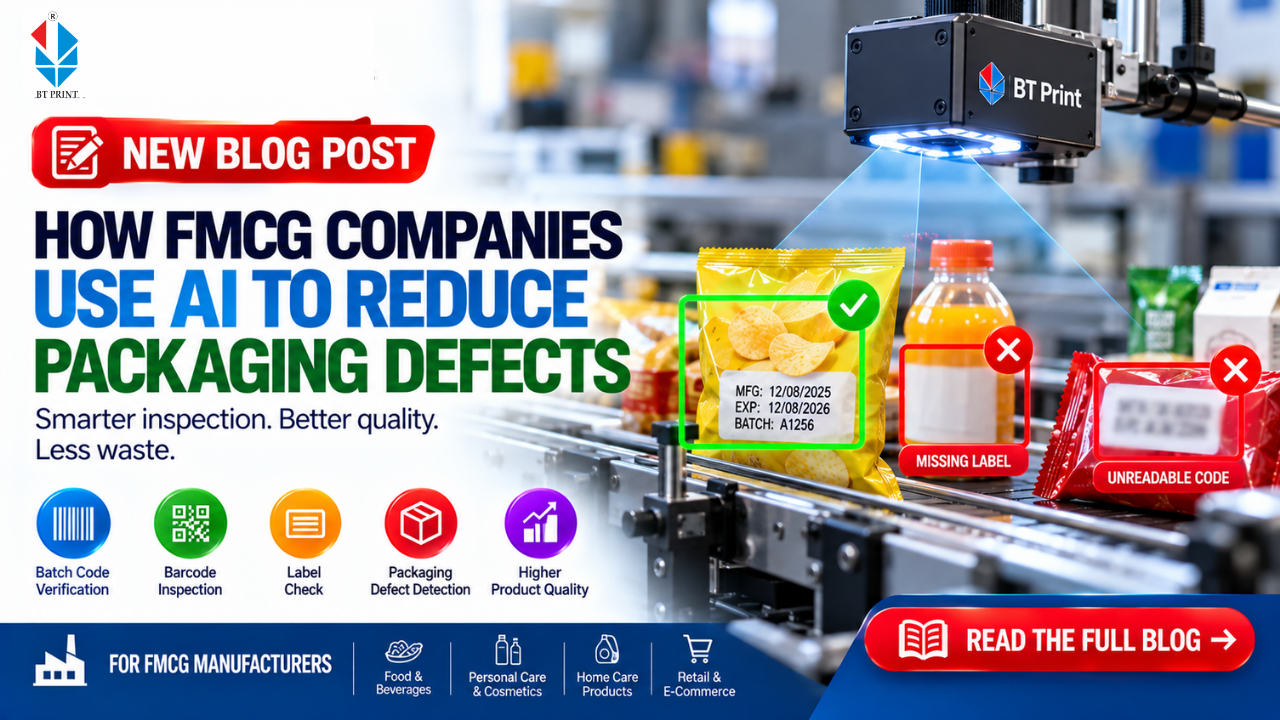
India's FMCG industry operates at an enormous scale. From biscuits, snacks and packaged beverages to personal care products, detergents and household essentials, manufacturers produce and pack thousands of products every hour. With such high production volumes, even a small packaging defect can result in product wastage, customer complaints and additional operating costs.
Traditional quality inspection still plays an important role in manufacturing. However, manually checking every package becomes increasingly difficult when production lines operate at high speeds or run 24×7.
This is where AI Vision Inspection Systems are becoming valuable for FMCG manufacturers. By using industrial cameras, image processing and intelligent software, manufacturers can automate many quality checks and identify packaging defects before products reach distributors, retailers or consumers.
For Indian FMCG companies looking to improve production efficiency, AI-powered inspection offers a practical way to strengthen quality control.
What Is AI Vision Inspection in FMCG Packaging?
An AI Vision Inspection System uses cameras and specialised software to examine products or packaging as they move through a production line.
The system captures images and checks them against predefined inspection criteria. Depending on the application, it can identify missing labels, incorrect printing, damaged packaging, misplaced codes and other visible defects.
Unlike manual inspection, an automated system can perform repetitive checks consistently without requiring an operator to visually examine every individual product.
Common inspection applications include:
- Missing or incorrect batch codes
- MFG and EXP date verification
- Barcode and QR code inspection
- Label position and presence
- Packaging damage
- Missing caps or components
- Incorrect product identification
- Print quality and readability
The exact inspection capability depends on the camera, lighting, software, product design and system configuration.
Why Packaging Defects Are a Challenge for FMCG Manufacturers
FMCG packaging lines frequently handle large production volumes, multiple product sizes and frequent packaging changes. Maintaining consistent quality across every product is not always easy.
1. Incorrect Batch Coding
Manufacturers must print the correct batch number, manufacturing date, expiry date and other required information. Incorrect or missing coding can create traceability problems and may lead to product rejection.
Integrating a vision system with a Batch Coding Machine can help verify whether the expected information has been printed correctly.
2. Missing or Misplaced Labels
A label that is missing, folded or incorrectly positioned can affect product presentation and identification. Automated vision inspection can detect many such defects when the camera and inspection criteria are configured appropriately.
3. Damaged Packaging
Crushed cartons, torn pouches, damaged containers and other visible defects can affect product quality and customer experience.
AI-assisted inspection can help identify defined types of packaging damage, depending on the product and inspection setup.
4. Incorrect Barcodes and QR Codes
A barcode may be printed but still be difficult to scan. Similarly, a QR code may be incomplete, distorted or incorrect.
A suitable vision system can check code presence and readability. Where actual encoded information must be verified, the system may also require barcode or QR code decoding and comparison against the expected data.
5. High-Speed Production
On a fast-moving packaging line, operators have very little time to inspect each product. Automated inspection can perform checks at production speeds supported by the system, reducing dependence on manual visual checking.
How AI Vision Systems Help Reduce Packaging Defects
1. Automated Inspection of Every Product
One of the biggest advantages of automated inspection is the ability to check individual products as they pass through the inspection point.
Instead of depending entirely on random sampling or manual observation, manufacturers can configure the system to inspect every product for specific defects.
This helps identify problems earlier and reduces the risk of defective packages moving further down the production line.
2. Batch Code and Expiry Date Verification
Incorrect date coding is a major concern for packaged food, beverages, personal care products and other FMCG categories.
A vision system can inspect printed batch numbers, MFG/EXP dates and other variable information.
For example, after a CIJ Printer or TIJ Printer prints the required code, the inspection system can check whether the code is present, correctly positioned and readable.
Where supported, OCR (Optical Character Recognition) or OCV (Optical Character Verification) can help read printed characters or compare them with an expected pattern.
This creates an additional quality-control step after coding.
3. Automatic Rejection of Defective Products
Detecting a defect is useful, but removing the defective product from the production line can make the process even more effective.
An AI Vision Inspection System can be integrated with a suitable rejection mechanism, conveyor controls or PLC.
When a product fails the configured inspection criteria, the system sends a signal to the rejection mechanism to remove it.
The process can be described simply:
PRINT → INSPECT → DETECT → REJECT
The reject mechanism must be properly synchronised with the conveyor speed and product position to avoid removing the wrong package.
4. Reduced Rework and Material Wastage
Packaging defects discovered late in production can be expensive to correct. Products may need to be opened, relabelled, recoded or repacked.
By detecting defects closer to the point where they occur, manufacturers can respond sooner and reduce unnecessary rework.
Inspection data can also help production teams identify recurring problems, such as a misaligned printer, inconsistent labelling or a packaging machine that needs adjustment.
5. More Consistent Quality Across Multiple Shifts
Many FMCG plants operate multiple shifts or continuous production schedules.
Manual inspection quality can vary with workload, fatigue and operator experience. Automated inspection applies the same configured checks throughout production, although system performance still depends on proper setup, maintenance and monitoring.
This can help maintain more consistent quality standards across different shifts.
Applications Across the Indian FMCG Industry
AI vision inspection can support a wide range of packaging applications in India.
Food and snacks: Inspection of printed dates, batch codes, labels, pouches and cartons.
Beverages: Verification of bottle codes, labels and selected packaging defects.
Dairy products: Inspection of date codes, labels and packaging on suitable containers.
Personal care and cosmetics: Checking product labels, printed information, caps and packaging presentation.
Home care products: Inspection of labels, batch codes and visible packaging defects on bottles, containers and cartons.
E-commerce and quick commerce packaging: Verification of barcodes, QR codes, printed information and selected defects on shipping boxes and bags.
For each application, manufacturers should test the actual product, packaging material, lighting conditions and line speed before finalising the inspection system.
Combining AI Vision with Coding and Marking Machines
AI inspection becomes especially useful when it works alongside industrial coding equipment.
For example, a manufacturer may use a CIJ Printer for high-speed coding on suitable products, or a TIJ Printer for high-resolution printing on compatible cartons and packaging materials.
A TTO Printer may be appropriate for variable information on compatible flexible packaging, while a Laser Marking Machine can be considered for suitable permanent-marking applications.
The AI vision system then checks the printed information or other defined packaging features.
This combination helps manufacturers move beyond simply printing a code towards verifying that the required information is present and acceptable.
What Should FMCG Manufacturers Consider Before Investing?
AI inspection is not a one-size-fits-all solution. Before selecting an AI Vision Inspection System, manufacturers should evaluate:
Production speed: The camera and processing system must handle the actual line speed.
Inspection requirements: Clearly define whether the system must check codes, labels, packaging damage or multiple defects.
Product variation: Different pack sizes, colours and designs may require separate inspection recipes.
Lighting and camera placement: Consistent image capture is essential for reliable inspection.
Rejection mechanism: Automatic rejection requires correct timing and integration with the production line.
Data and reporting: Determine whether production reports, defect counts and inspection records are required.
Maintenance and support: Cameras, lighting, software and reject mechanisms need regular checks.
Manufacturers should also conduct application trials to establish realistic detection performance and acceptable false-rejection rates.
How BT Print Supports Smarter FMCG Packaging
BT Print provides AI Vision Inspection Systems for suitable manufacturing and packaging applications, helping businesses automate checks for printed codes, labels and defined packaging defects.
Our industrial coding portfolio also includes CIJ Printers, TIJ Printers, TTO Printers, Laser Marking Machines and Batch Coding Machines.
These technologies can be considered for applications across food and FMCG, beverages, dairy, pharmaceuticals, cosmetics, e-commerce packaging and other manufacturing industries.
By combining suitable coding equipment with automated inspection and rejection, manufacturers can build a more controlled packaging process and identify defects earlier.
Conclusion
Packaging quality is an important part of FMCG manufacturing. Missing labels, incorrect batch codes, unreadable barcodes and damaged packages can create unnecessary waste, rework and customer complaints.
An AI Vision Inspection System helps manufacturers automate defined quality checks, verify printed information and identify defective products at production speed. When integrated with a suitable rejection mechanism, it can also remove failed products from the line.
For Indian FMCG companies operating high-volume or 24×7 production lines, the combination of coding, AI vision inspection and automatic rejection can strengthen quality control and support more efficient manufacturing.
The key is to choose a system based on actual packaging requirements, test it under real production conditions and maintain it properly.
BT Print — Smarter Coding. Smarter Inspection. Better Manufacturing.