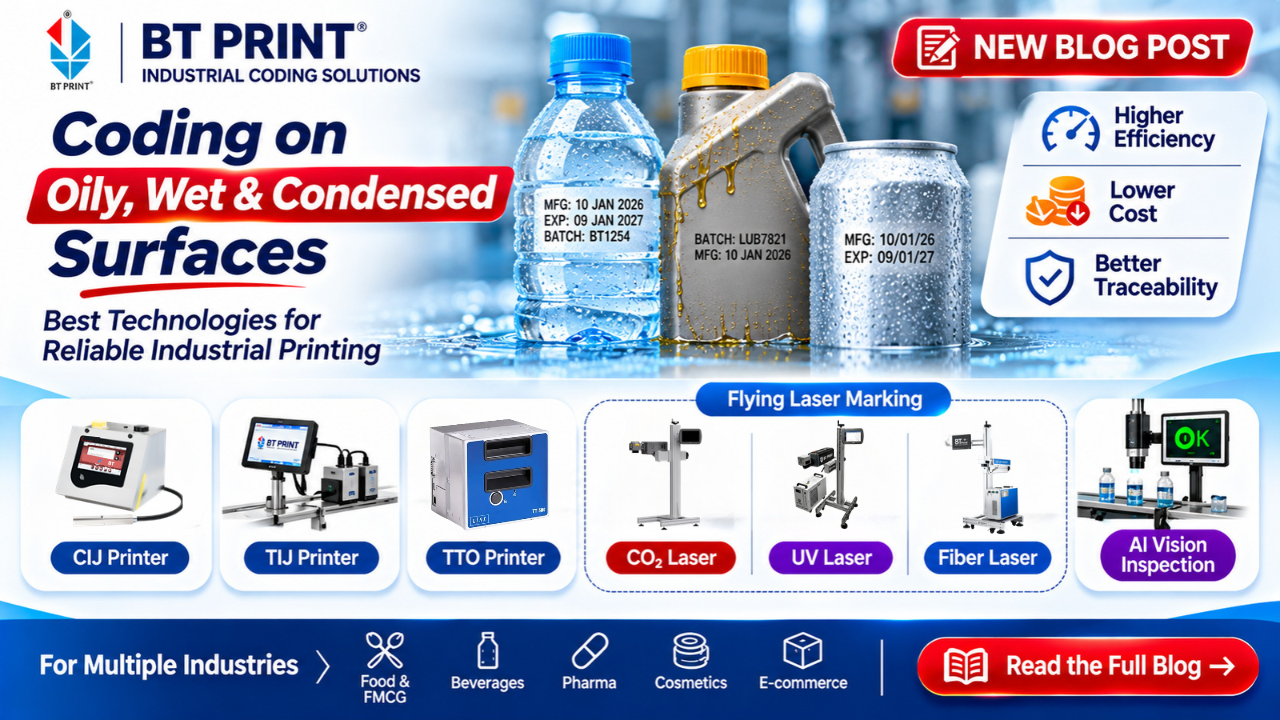
In modern manufacturing and packaging industries, product coding plays an important role in identification, traceability, quality control, and regulatory compliance. Manufacturers need to print essential information such as batch numbers, manufacturing dates, expiry dates, MRP, barcodes, QR codes, and product identification details on different types of packaging.
However, achieving consistent print quality is not always easy. Many production environments involve products with oily, wet, cold, or condensation-covered surfaces. Industries such as food and beverages, dairy, pharmaceuticals, automotive, lubricants, chemicals, and industrial manufacturing regularly face these challenges.
For example, packaged drinking water bottles may develop condensation after refrigeration. Dairy containers can carry moisture during filling and packaging. Lubricant bottles and metal components may have oil residues on their surfaces. In such conditions, conventional printing methods may experience poor ink adhesion, smudging, fading, or unreadable codes.
Choosing the right coding technology is essential to avoid these problems. In this guide, we will explain the challenges of coding on oily, wet, and condensed surfaces, compare different industrial coding technologies, and help manufacturers select the most suitable solution for their production lines.
1. Why Is Coding on Oily, Wet & Condensed Surfaces Difficult?
Industrial coding machines are designed to print on different packaging materials. However, surface conditions directly influence printing performance.
Let's understand the major challenges.
Poor Ink Adhesion
Ink needs to interact properly with the surface to create a durable and readable print. When oil, grease, or moisture is present, it can prevent the ink from adhering correctly.
This may result in:
- Ink not sticking to the packaging.
- Printed characters becoming faint.
- Codes rubbing off during handling.
- Poor print quality after packaging.
- Smudging and Blurred Printing
Water droplets and condensation can affect the drying process of certain inks. If a product moves immediately to the next packaging stage, the printed information may become blurred or smudged.
This is particularly challenging on high-speed beverage and dairy production lines.
Inconsistent Printing Quality
Changes in temperature, humidity, surface contamination, and packaging material can cause inconsistent results. A printer may produce good-quality codes during one production shift but experience problems under different environmental conditions.
Production Downtime
Frequent print failures can lead to cleaning, reprinting, product rejection, and unnecessary production interruptions.
Traceability and Compliance Risks
Unreadable batch numbers, manufacturing dates, and expiry dates can create difficulties during quality inspections, inventory management, and product recalls.
Therefore, manufacturers need a coding solution that matches their actual surface conditions and production requirements.
2. Best Technologies for Coding on Oily, Wet & Condensed Surfaces
Different industrial coding technologies offer different advantages. The correct choice depends on the packaging material, moisture level, oil contamination, production speed, and required print durability.
A. Continuous Inkjet (CIJ) Printer
Continuous Inkjet (CIJ) printers are widely used in industrial manufacturing for printing variable information on products moving through high-speed production lines.
CIJ technology works by continuously generating tiny ink droplets and directing selected droplets onto the product surface without physical contact.
This non-contact printing process makes CIJ printers suitable for many applications where products are moving continuously on conveyors.
Key advantages of CIJ printers:
- Non-contact printing on moving products.
- Suitable for high-speed production lines.
- Can print on different materials, including plastic, glass, and metal.
- Supports batch numbers, manufacturing dates, expiry dates, and product codes.
- Different ink formulations are available for different substrates.
- Can be integrated into automated packaging lines.
How does CIJ handle wet and condensed surfaces?
CIJ printing can be an effective option for certain wet or condensation-prone applications when the correct ink is selected.
For example, cold packaged drinking water bottles may develop moisture on their surfaces when they move from refrigerated storage into a humid production environment.
In such applications, manufacturers should evaluate inks designed for the specific bottle material and moisture conditions. Fast-drying or specialized inks may help achieve better results, depending on the application.
For oily surfaces, standard ink may not provide sufficient adhesion. Specialized inks and suitable surface preparation may be necessary.
Common applications:
- Packaged drinking water bottles.
- Carbonated soft drink bottles.
- Juice and beverage containers.
- Dairy packaging.
- Lubricant and engine oil bottles.
- Metal components and industrial products.
When should you choose CIJ?
Choose CIJ when you need continuous, non-contact coding at high production speeds and require flexibility across different packaging materials.
B. Thermal Inkjet (TIJ) Printer
Thermal Inkjet (TIJ) printers are widely used for high-resolution coding on cartons, labels, packaging films, and compatible product surfaces.
TIJ technology uses controlled heating to eject tiny ink droplets through a printhead. It can produce sharp text, logos, barcodes, QR codes, and variable product information.
Key advantages of TIJ printers:
- High-resolution printing.
- Sharp and readable characters.
- Suitable for barcodes and QR codes.
- Compact and easy to integrate.
- Convenient operation and cartridge replacement.
- Useful for variable-data printing.
Can TIJ print on wet or oily surfaces?
TIJ printing performance depends on the ink formulation and the surface material.
Standard water-based TIJ inks generally perform best on compatible, clean, dry, and absorbent surfaces.
For non-porous materials such as plastic, metal, and coated packaging, suitable solvent-based or specialty inks may be required.
However, moisture and oil can still affect adhesion and drying. Manufacturers should test the selected ink on actual products before installing the printer on a production line.
Common applications:
- Corrugated cartons.
- Outer packaging.
- Labels and packaging films.
- Selected plastic containers.
- Pharmaceutical packaging.
- High-resolution product identification.
When should you choose TIJ?
TIJ is a good option when print quality, barcode readability, QR codes, and compact installation are important, provided the packaging surface is compatible with the selected ink.
C. Laser Marking Machine
Laser marking is an advanced industrial coding technology that uses a focused laser beam to create marks on compatible materials.
Unlike inkjet printers, laser marking does not require ink or solvent. It creates a mark through controlled interaction between laser energy and the material surface.
This makes laser marking attractive for manufacturers looking to reduce ink consumption and produce durable identification marks.
Key advantages of laser marking:
- No ink or solvent consumption.
- Permanent marking on compatible materials.
- Low routine consumable requirements.
- Suitable for automated manufacturing lines.
- Can mark serial numbers, batch details, logos, and traceability codes.
- No ink drying time.
Can laser marking work on oily and wet surfaces?
Laser marking may be suitable for certain applications involving moisture or oil, but surface contamination should not be ignored.
Water droplets, oil films, and surface residues can affect laser energy absorption and marking consistency. They may also produce unwanted residue or interfere with the final marking quality.
Where necessary, the marking area should be cleaned or dried before processing.
The correct laser source depends on the material:
1. Fiber Laser Marking Machine
Fiber lasers are commonly used for marking metals and selected industrial materials.
Applications include:
- Stainless steel components.
- Aluminium parts.
- Automotive components.
- Metal tools and machinery.
- Industrial identification plates.
2. CO? Laser Marking Machine
CO? lasers are suitable for many non-metallic materials, including selected plastics, paper, cardboard, and packaging materials.
Applications include:
- Packaging materials.
- Cartons and boxes.
- Selected plastic products.
- Labels and other compatible substrates.
3. UV Laser Marking Machine
UV lasers are used for fine and precise marking on selected sensitive materials and plastics where controlled marking is required.
Applications include:
- Selected plastic packaging.
- Electronics.
- Small components.
- Products requiring fine identification marks.
When should you choose laser marking?
Laser marking is worth considering when you need durable, ink-free marking on a compatible material. However, actual product testing is important, especially when the surface contains oil, water, or condensation.
D. Drop-on-Demand (DOD) Printing
Drop-on-Demand (DOD) technology is used in selected industrial coding applications where larger characters or specific printing requirements are needed.
It deposits ink only when required, making it suitable for certain carton, packaging, and industrial marking applications.
Key advantages:
- Suitable for selected large-character printing requirements.
- Can be integrated into industrial production lines.
- Useful for printing product identification and packaging information.
- Available in different configurations depending on application needs.
- Its performance on oily or wet surfaces depends on ink compatibility, substrate, printing distance, and environmental conditions.
Before selecting DOD technology, manufacturers should evaluate print quality and adhesion under actual operating conditions.
3. Industry-Wise Applications of Coding on Wet and Oily Surfaces
Different industries face different surface-related coding challenges.
Food and Beverage Industry
Beverage manufacturers often handle chilled bottles, cans, and containers. Condensation may form on packaging surfaces due to temperature differences.
CIJ printers with compatible ink formulations are commonly considered for printing batch numbers and manufacturing or expiry dates on moving bottles and containers.
Dairy Industry
Milk bottles, yogurt containers, and other dairy packaging may be exposed to moisture during filling, cooling, and handling.
The selected coding technology should provide readable codes and suitable adhesion under the actual production conditions.
Lubricant and Automotive Industry
Oil bottles, lubricant containers, metal components, and automotive parts may have oily or greasy surfaces.
Manufacturers should consider specialized CIJ inks, suitable surface preparation, or laser marking depending on the substrate and required durability.
Pharmaceutical Industry
Pharmaceutical packaging requires accurate and readable product information.
TIJ and CIJ printers are used for different packaging applications, including cartons, labels, bottles, and selected containers. The correct solution depends on packaging material, production speed, and coding requirements.
Chemical Industry
Chemical containers and industrial packaging may involve challenging surface conditions.
Manufacturers should consider the compatibility of the ink or marking process with the container material and the expected handling environment.
4. How to Select the Right Coding Machine for Your Production Line
Choosing the right coding machine is not simply about comparing printer prices. Manufacturers should evaluate the complete production environment.
Here are seven important factors to consider.
1. Identify the packaging material
Determine whether the product is made from PET, HDPE, glass, metal, cardboard, coated packaging, or another material.
Different materials require different ink formulations or laser configurations.
2. Understand the surface condition
Check whether the surface is:
- Completely wet.
- Covered with condensation.
- Contaminated with oil or grease.
- Dusty or dirty.
- Cold due to refrigeration.
- Coated or chemically treated.
3. Check production speed
The printer should match the speed of your conveyor or packaging line. A solution that works at a slow speed may not deliver the same results at higher production speeds.
4. Select compatible ink or laser technology
For inkjet printing, check ink adhesion, drying time, and resistance to water or oil.
For laser marking, check material compatibility, marking contrast, and the effect of surface contamination.
5. Evaluate code durability
Check whether the code remains readable after:
- Drying.
- Handling.
- Packaging.
- Transportation.
- Storage.
- Normal cleaning or exposure conditions.
6. Consider operating costs
Compare ink consumption, maintenance requirements, spare parts, energy consumption, and service support.
The lowest initial machine price does not always mean the lowest long-term operating cost.
7. Conduct real production trials
This is one of the most important steps.
Always test the printer using actual products, actual packaging materials, and normal production conditions. A successful demonstration on a clean sample may not guarantee the same performance on a wet or oily production line.
8. Practical Tips to Improve Coding Quality
Even the best coding machine needs proper installation and operating conditions.
Manufacturers can improve coding consistency by following these practices:
- Keep the coding area as clean as practical.
- Remove excess moisture or oil where the production process allows.
- Use inks recommended for the specific substrate and application.
- Maintain the correct printhead-to-product distance.
- Check the printer's position and product alignment.
- Test printing at actual production speed.
- Allow sufficient drying time where required.
- Verify code adhesion after printing.
- Schedule regular maintenance and cleaning.
- Inspect printed codes during production.
These simple steps can reduce print failures, minimize production interruptions, and improve product traceability.
7. Common Mistakes to Avoid
Manufacturers sometimes experience coding problems because the printer is selected without considering actual surface conditions.
Avoid these common mistakes:
Using standard ink for every application: Different materials and surface conditions require different ink properties.
Ignoring condensation: Moisture on cold products can affect ink performance even when the packaging material itself is suitable.
Selecting a printer only by price: Consider operating costs, print quality, maintenance, and service availability.
Skipping production trials: Always validate the selected technology before full-scale installation.
Ignoring maintenance: Incorrect cleaning, poor installation, and improper operating conditions can affect printing consistency.
Avoiding these mistakes helps manufacturers achieve more reliable coding performance.
8. Why Choose BT PRINT for Industrial Coding Solutions?
Selecting the right coding technology is an important decision for any manufacturing business. BT PRINT offers industrial coding and marking solutions designed for different packaging materials, production environments, and manufacturing applications.
Its product portfolio includes:
- Continuous Inkjet (CIJ) Printers.
- Thermal Inkjet (TIJ) Printers.
- UV Laser Marking Machines.
- Fiber Laser Marking Machines.
- CO? Laser Marking Machines.
Industrial Coding and Marking Solutions.
BT PRINT supports manufacturers across industries such as food and beverages, dairy, pharmaceuticals, cosmetics, personal care, lubricants, automotive, packaging, and general manufacturing.
Whether your production line handles plastic bottles, cartons, metal components, or industrial containers, the right solution should be selected according to your actual application.
With Pan India service support, BT PRINT helps manufacturers evaluate coding requirements and identify suitable industrial printing and marking solutions.
9. Frequently Asked Questions (FAQs)
Q1. Which printer is best for coding on wet plastic bottles?
CIJ printers with compatible ink formulations are commonly considered for coding on wet or condensation-prone plastic bottles. However, the final choice depends on the bottle material, moisture level, and production conditions.
Q2. Can a CIJ printer print on oily surfaces?
Yes, CIJ printing may be suitable for certain oily surfaces when the correct specialized ink is used. Surface preparation and application testing are important for reliable results.
Q3. Is TIJ printing suitable for wet surfaces?
TIJ performance depends on the ink and packaging material. Standard water-based inks generally require compatible, clean, and dry surfaces. Certain specialty inks may support other applications, but testing is essential.
Q4. Can laser marking replace inkjet printing?
Laser marking can replace inkjet printing in suitable applications where the material is compatible with laser processing and durable, ink-free marking is required. However, it is not suitable for every packaging material.
Q5. Which laser is best for metal marking?
Fiber laser machines are commonly used for marking metals such as stainless steel and aluminium. The final selection depends on the material, marking requirements, and production speed.
Q6. How can I prevent batch code smudging?
Use compatible ink, maintain correct printer settings, manage surface moisture, allow sufficient drying time, and conduct adhesion tests under actual production conditions.
Q7. Should I test a coding machine before purchasing?
Absolutely. Testing with actual products and packaging materials is the best way to evaluate print quality, adhesion, readability, and performance.
Conclusion
Coding on oily, wet, and condensed surfaces is a common challenge across modern manufacturing industries. Poor ink adhesion, smudging, inconsistent print quality, and production downtime can affect productivity and product traceability.
The right coding technology depends on the packaging material and production environment. CIJ printers are suitable for many high-speed industrial applications with compatible inks. TIJ printers offer high-resolution printing on compatible surfaces, while laser marking provides an ink-free option for materials that respond well to laser energy. DOD printers can also be considered for selected industrial marking requirements.
The most reliable approach is to understand your surface conditions, evaluate the available technologies, and conduct real production trials before making a final decision.
Looking for a reliable coding solution for oily, wet, or condensation-prone surfaces?
Contact BT PRINT to discuss your production requirements and explore the right industrial coding and marking solution for your business.