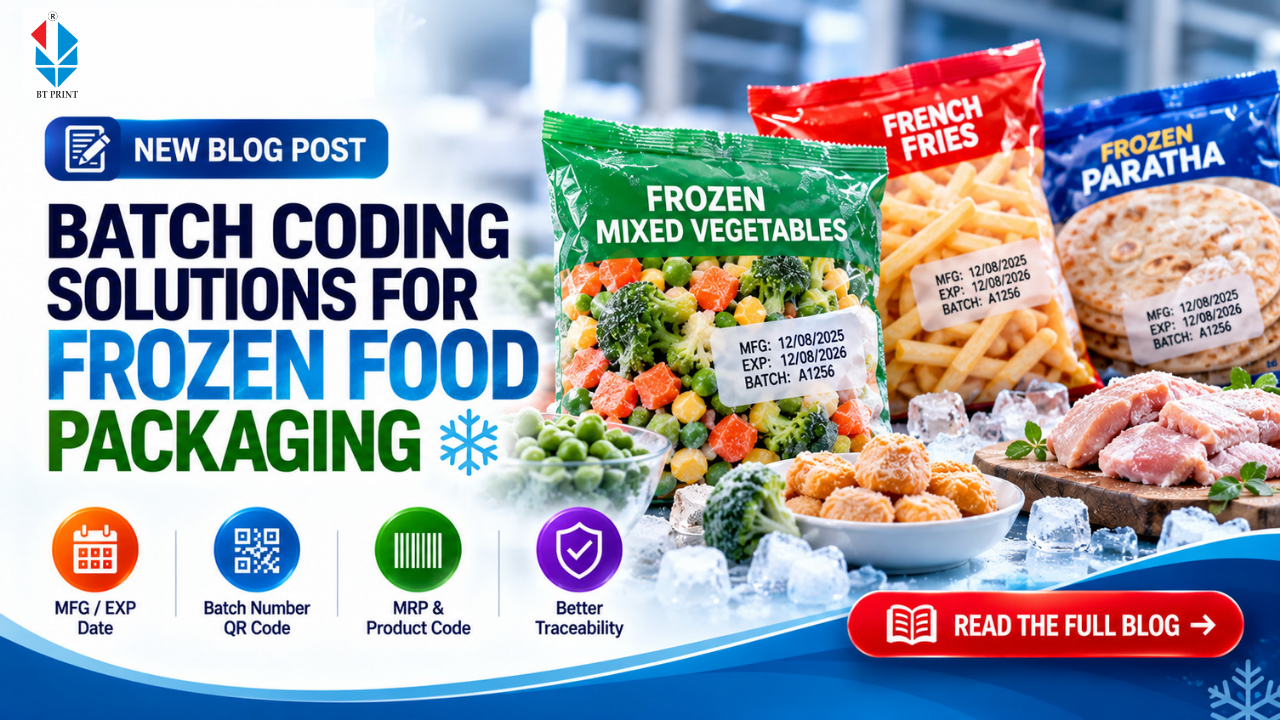
The frozen food industry is growing rapidly, with products such as frozen vegetables, French fries, frozen snacks, parathas, ready-to-cook meals, seafood and meat products becoming increasingly common in Indian households, retail stores and quick commerce deliveries.
As production volumes increase, manufacturers also need reliable ways to identify and track every product leaving the factory. Batch numbers, manufacturing dates, expiry dates, MRP, product codes and other variable information need to be printed clearly on the packaging.
This is where the right batch coding machine becomes an important part of the packaging line.
However, frozen food packaging is not always an easy coding application. Low temperatures, moisture, condensation, flexible films, laminated packaging and high-speed production can all influence printing performance.
For this reason, manufacturers should select a coding technology based on their actual packaging material, production speed, print requirements and operating environment.
Why Batch Coding Is Important for Frozen Food Packaging
Batch coding is an essential part of product identification and traceability.
A properly printed code helps manufacturers, distributors and retailers identify products from a particular production batch. If a quality or inventory issue occurs, batch information can also help manufacturers identify and manage the affected products more efficiently.
Depending on the product and packaging format, frozen food manufacturers may need to print:
- Batch or lot number
- Manufacturing date
- Expiry or best-before date
- MRP
- Product code
- Shift information
- Barcodes
- QR codes
- Variable production information
Printing this information manually is difficult when production volumes are high. An automated batch coding printer can provide faster and more consistent coding while reducing manual intervention.
Coding Challenges in Frozen Food Packaging
Frozen food manufacturers have some specific coding challenges that need to be considered before selecting a printer.
Cold and Moisture
Production and packaging areas may have low temperatures and high humidity. Condensation can also occur when products move between cold storage and warmer environments.
The ink, printing technology and substrate combination therefore needs to be selected carefully.
Flexible Packaging
Many frozen foods are packed in pouches, plastic films and laminated materials. These materials may require different printing technologies depending on the packaging structure and production process.
High-Speed Production
Large frozen food plants can operate automated packaging lines at high speeds. The coding system needs to keep pace with the production line without affecting throughput.
Small Printing Areas
Batch numbers and dates often need to fit into a relatively small area on the package while remaining readable.
Long Production Hours
Many food manufacturers operate multiple shifts or 24×7 production. Printer reliability, maintenance and consumable management therefore become important considerations.
1. CIJ Printers for High-Speed Frozen Food Production
A CIJ Printer is one of the most widely used technologies for continuous industrial coding.
CIJ, or Continuous Inkjet, is a non-contact printing technology. The printhead can apply the required code while the product or package is moving on a conveyor.
This makes CIJ suitable for high-speed applications where production cannot be stopped for coding.
Depending on the selected ink and application, a CIJ printer can print:
- Batch numbers
- MFG dates
- EXP dates
- MRP
- Lot numbers
- Product codes
- Variable information
CIJ can be considered for suitable frozen food applications involving bottles, containers, plastic packaging and other compatible substrates.
The correct ink should always be selected based on the packaging material, environmental conditions and required durability.
For manufacturers running high-speed production lines, a CIJ Printing Machine can provide a practical solution for continuous batch and date coding.
2. TIJ Printers for High-Resolution Coding
A TIJ Printer uses Thermal Inkjet technology to produce high-resolution printing on suitable substrates.
TIJ can be particularly useful when manufacturers need clear text, barcodes, QR codes or other variable information.
Suitable applications may include:
- Cartons
- Corrugated boxes
- Paper packaging
- Kraft-based packaging
- E-commerce packaging
- Quick commerce packaging
- Other compatible packaging materials
For frozen food manufacturers supplying products through modern retail, e-commerce and quick commerce channels, readable barcodes and QR codes can become increasingly important.
A batch coding printer based on TIJ technology can provide sharp and readable variable information when the correct ink and substrate combination is used.
Bulk Ink for High-Consumption TIJ Applications
Some frozen food packaging lines operate continuously and consume a significant amount of ink.
For suitable high-consumption TIJ applications, a Bulk Ink System can reduce the need for frequent replacement of small ink cartridges.
BT Print's suitable TIJ solutions with bulk ink can provide up to 40% cost savings, depending on factors such as print coverage, production volume, ink consumption and application conditions.
Bulk ink can also help reduce operator intervention and support longer printing runs.
For manufacturers operating multiple shifts, this can make consumable management easier and help improve production continuity.
3. TTO Printers for Flexible Frozen Food Packaging
Flexible packaging is widely used for frozen food products.
Frozen vegetables, snacks, fries, parathas and ready-to-cook products are often packed using films and laminates.
For suitable flexible packaging applications, a TTO Printer can provide high-resolution variable printing directly onto compatible packaging materials.
Typical information can include:
- Manufacturing date
- Expiry date
- Batch number
- MRP
- Barcodes
- Variable product information
TTO technology can be particularly useful when the printing process needs to be integrated with automated packaging equipment.
However, the correct ribbon, printhead configuration and packaging material should be evaluated before implementation.
4. Laser Marking Machines for Frozen Food Packaging
Laser marking is another technology that frozen food manufacturers can consider for suitable packaging applications.
Unlike ink-based printing systems, a Laser Marking Machine creates a mark using a focused laser beam. This means there is no conventional ink or ribbon involved in the marking process.
Depending on the packaging material and application, laser technology can be used for marking information such as:
- Batch numbers
- Production codes
- Date information
- Product identification
- Traceability information
For suitable films, laminates, plastics, cartons and other compatible substrates, laser marking can provide a durable and clean marking solution.
CO2 Laser for Suitable Packaging Materials
A CO2 Laser Marking Machine is commonly considered for applications involving suitable non-metallic materials.
For frozen food packaging, the actual suitability depends heavily on the film or laminate construction, coatings, colour and required contrast.
For example, two packaging films that look similar from the outside may respond differently to laser marking because their internal layers and coatings are different.
Therefore, manufacturers should conduct application testing before selecting a laser system.
Benefits of Laser Marking
For suitable applications, laser marking can offer:
- No traditional ink or ribbon consumption
- Contactless marking
- Permanent or durable marking options
- High-speed operation
- Reduced consumable dependency
- Potential integration with automated production lines
Laser technology can be particularly attractive for manufacturers looking to reduce consumable handling on appropriate packaging applications.
However, laser marking is not suitable for every frozen food package. The packaging material, laminate structure, required contrast, marking speed and product requirements must be evaluated before choosing the technology.
5. AI Vision Inspection for Coding Quality
Printing the correct information is only one part of the process.
Manufacturers also need to make sure the code has actually been printed correctly.
An AI Vision Inspection System can be used as an additional quality-control solution.
Depending on the application, the system can inspect:
- Batch codes
- Manufacturing and expiry dates
- Barcodes
- QR codes
- Labels
- Missing prints
- Incorrect prints
When integrated with an automatic rejection mechanism, products with incorrect or missing information can be removed from the production line.
This creates a simple automated process:
PRINT → INSPECT → DETECT → REJECT
For frozen food manufacturers handling large production volumes, automated inspection can help reduce dependence on manual checking.
How to Choose the Right Coding Solution
There is no single coding machine that is ideal for every frozen food application.
Before purchasing a batch coding machine, manufacturers should evaluate several factors.
Packaging Material
Determine whether the product uses plastic film, laminated film, pouch material, carton, paperboard or another substrate.
Production Speed
The printer should be able to match the speed of the packaging line.
Print Content
Simple batch and date information may have different requirements compared with high-resolution QR codes and barcodes.
Environmental Conditions
Consider temperature, humidity, condensation and the location of the printer relative to the frozen product and packaging process.
Print Durability
The code should remain readable during storage, transportation, handling and distribution.
Consumable Cost
Consider ink, cartridges, ribbons and other consumables when calculating the overall cost of ownership.
Maintenance
A reliable preventive maintenance routine is important, especially when the production line operates for long hours.
Batch Coding and Traceability in the Frozen Food Supply Chain
Frozen food products may travel through several stages before reaching the final customer.
The product can move from:
Manufacturer → Cold Storage → Distributor → Retailer → Consumer
Clear batch coding helps identify products throughout this journey.
If a product quality issue occurs, accurate batch information can help manufacturers identify the relevant production lot and manage inventory more effectively.
This makes reliable industrial coding solutions an important part of modern frozen food manufacturing.
Maintenance Is Essential for Reliable Coding
The performance of a batch coding printer depends not only on the technology but also on proper maintenance.
Operators should regularly check:
- Ink or consumable levels
- Printhead condition
- Print quality
- Printer alarms
- Print position
- Cleaning requirements
- Fluid levels where applicable
For CIJ systems, proper startup and shutdown procedures are especially important.
For TIJ systems, printhead and cartridge condition should be monitored.
For TTO systems, ribbon condition and printhead performance should be checked.
For laser systems, manufacturers should maintain the laser marking equipment according to the manufacturer's recommended service schedule.
BT Print Coding Solutions for Frozen Food Manufacturers
BT Print provides a range of Industrial Coding Solutions for food and packaging manufacturers.
Depending on the application, manufacturers can consider:
These solutions can support suitable applications across Frozen Food, Food & FMCG, Beverages, Dairy, Pharmaceuticals, Cosmetics, E-Commerce Packaging and Quick Commerce Packaging.
The right technology depends on the product, packaging material, production speed and required coding information.
Final Thoughts
Frozen food packaging requires reliable coding because products must remain identifiable throughout manufacturing, storage, distribution and retail.
The right batch coding machine depends on the specific application.
A CIJ Printer can be suitable for high-speed continuous coding, while a TIJ Printer can provide high-resolution printing on compatible packaging materials. For suitable flexible packaging, a TTO Printer can be considered, while a Laser Marking Machine can provide durable marking on compatible films, plastics, cartons and other substrates.
For high-consumption TIJ applications, a Bulk Ink System can help reduce frequent cartridge replacement and may provide up to 40% cost savings depending on the application.
Where automated quality verification is required, an AI Vision Inspection System can add another layer of protection by checking printed information and enabling defective products to be rejected.
The key is not simply choosing the most advanced printer. It is choosing the right coding technology for the right packaging material and production environment.
For frozen food manufacturers, a well-planned coding system can help improve traceability, maintain readable product information and support efficient high-volume production.
BT Print — Smart Coding, Marking & Inspection Solutions for Modern Food & Packaging Industries