The pharmaceutical industry demands a high level of accuracy at every stage of manufacturing and packaging. From tablets and capsules to syrups, injections, ointments and medical products, every package must meet strict quality requirements. Incorrect batch numbers, unreadable expiry dates, missing labels or defective packaging can create serious quality, traceability and compliance concerns.
In India, pharmaceutical manufacturers supply products to domestic and international markets, making reliable packaging inspection an important part of production. As manufacturing lines become faster and more automated, manual inspection alone may not be sufficient to identify every defect consistently.
This is where an AI Vision Inspection System can make a meaningful difference. By combining industrial cameras, image processing and intelligent inspection software, manufacturers can automate selected quality checks, identify packaging defects and help prevent non-conforming products from moving further along the production line.
In this blog, we explore why AI vision inspection is becoming increasingly important in pharmaceutical manufacturing and how it can improve packaging quality.
What Is an AI Vision Inspection System?
An AI Vision Inspection System uses cameras and specialised software to capture and analyse images of products or packaging during production. The system checks the captured images against defined inspection criteria to identify missing, incorrect or defective features.
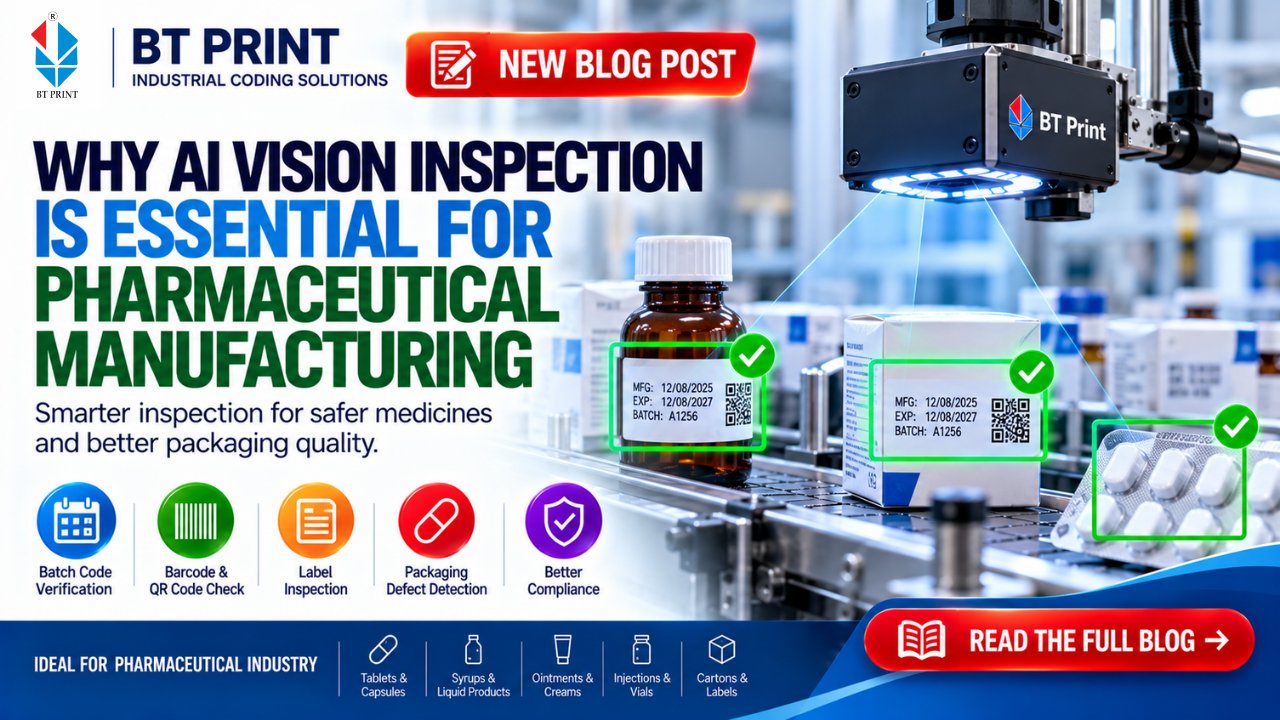
Depending on the application and configuration, the system can inspect:
- Batch numbers and manufacturing dates
- Expiry dates and other printed information
- Barcode and QR code presence and readability
- Labels and their positioning
- Missing caps, closures or packaging components
- Visible defects in cartons, bottles and other packaging
- Incorrect product identification or packaging variants
Some systems use OCR (Optical Character Recognition) to read printed characters, while OCV (Optical Character Verification) can compare printed information against expected characters or patterns.
AI-based inspection can also help identify certain visual defects that are difficult to detect consistently through simple rule-based checks. However, actual performance depends on the camera, lighting, software, product variation and inspection conditions.
Why Is AI Vision Inspection Important for Pharmaceutical Manufacturing?
1. Accurate Batch Number and Expiry Date Verification
Batch numbers, manufacturing dates and expiry dates are essential for pharmaceutical product identification and traceability.
A missing digit, incorrect date or poorly printed batch code can create problems during distribution and quality checks. These errors may occur because of incorrect printer settings, a wrong production recipe, poor print quality or changes made during product changeovers.
An AI vision inspection system can check whether the required information is present, readable and consistent with configured inspection rules.
When integrated with a suitable Batch Coding Machine, it can inspect codes printed on cartons, labels, bottles, blister packaging and other compatible surfaces.
For example, after a coding printer marks an expiry date on a medicine carton, the vision system can capture the printed area and verify the characters against the expected information, where supported.
This adds an additional verification step to the packaging process.
2. Detecting Missing or Incorrect Labels
Pharmaceutical packaging often contains important information, including product names, strengths, dosage details, batch information, and expiry dates.
A missing or incorrect label can create identification and traceability risks.
AI-assisted vision inspection can help detect missing labels, misplaced labels, incorrect label variants and selected printing defects. For applications requiring confirmation of the label's actual content, the system must be configured to read or compare the relevant information rather than checking appearance alone.
This is particularly useful for manufacturers handling multiple products and packaging formats on the same production line.
3. Barcode and QR Code Inspection
Barcodes and QR codes are used in pharmaceutical packaging for identification, tracking and other product-information purposes.
A code that is damaged, incomplete or difficult to scan may cause problems during downstream verification and distribution.
A suitable vision inspection system can check code presence, print quality and readability. Where required, it can also decode the barcode or QR code and compare the information with the expected data.
Indian pharmaceutical manufacturers should select inspection capabilities according to the applicable regulatory requirements and their specific packaging and traceability processes.
Automated inspection can support these processes, but it does not replace the complete regulatory compliance or product-traceability system.
4. Identifying Visible Packaging Defects
Packaging defects can occur at different stages of pharmaceutical production. Examples include damaged cartons, poorly positioned labels, missing caps, incorrect closures and visible print defects.
A properly configured vision system can identify selected defects before products move to the next stage.
For example, in a bottle packaging line, the system may inspect whether the label is present, the printed code is readable and the cap is correctly positioned, provided the equipment is designed and validated for those checks.
The inspection system can therefore help reduce dependence on manual visual checking for repetitive tasks.
It is important to define the scope clearly: a packaging vision system does not automatically detect every possible product defect, contamination issue or internal tablet defect unless it has the appropriate inspection technology and configuration.
5. Automatic Rejection of Defective Products
Detecting a defect is only one part of quality control. Removing or segregating the affected product is equally important.
An AI Vision Inspection System can be integrated with a suitable reject mechanism, conveyor controls or PLC to trigger the rejection of products that fail configured inspection criteria.
A typical process works as follows:
PRINT → INSPECT → DETECT → REJECT
1. A coding machine prints the required product information.
2. An industrial camera captures the printed code or packaging image.
3. The software checks the product against defined criteria.
4. If a defect is detected, the system sends a rejection signal.
5. The reject mechanism removes or diverts the product for further investigation.
Correct timing, product tracking and reject confirmation are essential, particularly on high-speed production lines.
For pharmaceutical applications, rejected products should be handled under documented procedures, with appropriate records and investigation where required. Automatic rejection should be part of a controlled quality process rather than a substitute for it.
6. Supporting High-Speed and 24×7 Production
Many pharmaceutical manufacturing facilities operate long production shifts, and some packaging lines run continuously to meet demand.
Manual inspection becomes challenging when operators must examine thousands of packages while maintaining concentration throughout a shift.
Automated vision inspection can perform configured checks repeatedly at production speeds supported by the equipment. It can also generate inspection results that help production and quality teams identify recurring problems.
For example, repeated detection of unreadable expiry dates may indicate a coding problem that requires investigation. Identifying the issue early can help teams correct the cause before more products are affected.
AI inspection does not eliminate the need for trained operators, maintenance and periodic performance verification. Instead, it helps them focus on exceptions and corrective action.
7. Improving Documentation and Quality Monitoring
Pharmaceutical manufacturers need controlled processes and appropriate records to support quality management.
Depending on the system, AI vision inspection equipment can record defect counts, inspection results, timestamps and other production information.
These records can help teams analyse recurring defects, compare performance between production runs and identify opportunities for improvement.
For applications requiring electronic records, audit trails or integration with manufacturing and quality systems, manufacturers should evaluate the available features and validate the system for its intended use.
Inspection reports can support quality investigations, but they do not automatically establish regulatory compliance.
Which Coding Technologies Can Work with AI Vision Inspection?
AI inspection can be combined with different industrial coding technologies, depending on the product and packaging material.
CIJ Printer
A CIJ Printer is suitable for high-speed coding applications on compatible surfaces, including many bottle and container packaging lines. Vision inspection can verify the presence and readability of printed codes.
TIJ Printer
A TIJ Printer can produce high-resolution text and codes on compatible packaging materials, such as cartons and selected labels. Inspection can check the printed information against configured requirements.
Laser Marking Machine
A Laser Marking Machine can provide permanent marking on suitable materials. The correct laser type and settings depend on the substrate and marking requirements. A vision system can inspect the resulting mark where suitable.
The right combination depends on the packaging material, code requirements, production speed, inspection scope and required integration.
What Should Pharmaceutical Manufacturers Consider Before Installation?
Before investing in an AI vision inspection solution, manufacturers should assess the following:
Inspection requirements: Decide whether the priority is code verification, label inspection, packaging defects or multiple checks.
Production speed: Ensure that the camera, processing hardware and rejection mechanism can handle the actual line speed.
Packaging variation: Consider different carton sizes, label designs, product colours and printing locations.
Lighting and camera placement: Stable image capture is essential for reliable results.
Data integration: Identify whether the system must communicate with a printer, PLC, production software or quality management system.
Validation and documentation: Establish acceptance criteria, test performance and maintain appropriate records for the intended pharmaceutical application.
After-sales support: Plan for maintenance, troubleshooting and periodic performance checks.
A practical application trial using actual packaging samples is strongly recommended before finalising the system.
How BT Print Supports Pharmaceutical Packaging Quality
BT Print offers AI Vision Inspection Systems and industrial coding solutions for suitable manufacturing and packaging applications.
Our portfolio includes CIJ Printers, TIJ Printers, Laser Marking Machines and Batch Coding Machines that can be evaluated alongside vision inspection for pharmaceutical packaging requirements.
Depending on the application, these technologies can help manufacturers print product information, verify selected packaging characteristics and identify defects before products proceed further along the line.
The objective is to help businesses build a more consistent and controlled packaging process through suitable equipment selection and integration.
Conclusion
Pharmaceutical manufacturing requires accuracy, traceability and consistent packaging quality. Incorrect expiry dates, missing batch codes, unreadable barcodes and defective labels can create avoidable production and quality challenges.
An AI Vision Inspection System helps automate defined inspection tasks, verify printed information and detect selected packaging defects. When integrated with suitable coding equipment and rejection mechanisms, it can strengthen quality control on high-speed production lines.
For Indian pharmaceutical manufacturers, the most effective approach is to select a system based on actual production needs, validate its performance and integrate it into a documented quality process.
BT Print — Smarter Coding. Smarter Inspection. Better Manufacturing.